
Have you ever felt as though you were standing on holy ground? For reasons we may not fully understand, certain places feel special. The earth beneath our feet may not quake, but we might feel a tad woozy! What starts as a casual visit or passing through turns into something altogether different because something captures our attention. The moment becomes fuller, richer even. We may feel strangely warmed, as though we are accompanied by an invisible guest. It could cause goose bumps. If it is does, you may echo a friend of mine who said, “It was like somethin’ got ahold of me!”
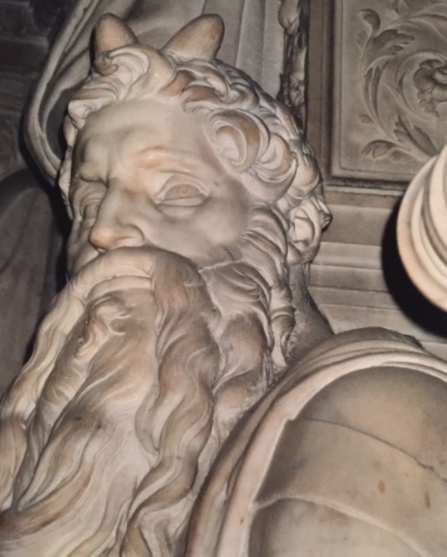
If you are familiar with the Biblical accounts of Moses at the burning bush or receiving stone tablets on the mountain then you have a reference point for dramatic versions of holy ground. The photo accompanying this blog, taken on a trip to Italy, is Michelangelo’s attempt to portray Moses’ radiance after spending time on the mountain in the presence of the Divine. In the sculpture, it appears that Moses has small nubs on top of his head, similar to a young calf ready to be dehorned. Perhaps Michelangelo imagined he was feeling bullish as he made his way back down the mountain!
Holy ground moments are often described dramatically but they also happen in quieter, simpler fashion. Like when I visit my favorite stream or sit under a preferred tree or even hold one of the glacier-deposited granite stones on my property. Spring gardening is another occasion where sun, silence, and soil seem to be necessary ingredients for a religious moment. Holy ground is what we experience when we realize the Divine is in our midst, especially if we connect that experience with the place itself.
There is a print of a Doyle Penrose painting called Presence in the Midst that hangs in many Quaker meetinghouses. It depicts Christ standing in the midst of a group of Quakers sitting in silent worship. This piece of art has always moved me because it so simply captures the sense of what creates holy ground, wherever it occurs. Some places really do rise to the level of holy ground, or sacred space, if you will. But if we think only in terms of space, we may miss the fact that it is the Presence of the Holy that illuminates the experience, and that Presence is not tied to physical spaces. Early Quakers were adamant that steeple houses were not, in fact, the abode of God. Rather, it was the gathering—the meeting of seekers & worshippers, lost & found, young & old—that mattered. They were the Church, not the building. With that, it seems simple to shift from tying holiness only to ground and geography, and think instead of holy moments—encounters with others—as opportunities where divine presence is noticed and grace flourishes.
Several years ago I participated in an educational tour that included a visit to the Vatican, plus an audience with the Pope. Curiosity and a love for seeing new things made it an interesting opportunity, but being non-Catholic I had low expectations in the visit as a religious experience. It required waiting in a long line followed by an uncomfortable seat in a huge auditorium that was filled with throngs of people. Honestly, as we waited I could feel the contrariness and sarcasm you might expect of a non-creedal Quaker plopped in the middle of a high church moment. That began to change soon after the Pope was seated on the stage, but not because of his ecclesiastical standing. I must confess my attitude was transformed while witnessing the exuberance of the various groups in attendance as the pope recognized them one by one. When the pontiff read their names, they stood, cheered, and frequently sang songs they had written to express their joy and devotion at being greeted and receiving a papal blessing. It would not be a metaphorical exaggeration to say my heart melted. For many of these pilgrims, this clearly felt like the opportunity of a lifetime. They had traveled miles for this explicit moment. No doubt place held some importance for these groups, but this was an occasion where the holiness was less about location and more about an encounter in which they experienced God as particularly present in the exchange. The exchange, though still with some distance between their location in the auditorium and the pope’s seat, was close enough to convey a sense of being seen, recognized, and known. They drank in the papal blessing delivered especially for them like it was nectar from the gods (which, I suppose in a sense it was!). For these pilgrims, God was present in that moment.
As I think about life and faith, an important question is, “Is God only experienced in officially sanctioned rituals?” Asked differently, “How present or knowable is the divine in the midst of the mundane?” Or, “How compartmentalized is life anyway? Is spiritual stuff only for certain times and places?” This is one place where Quakers make an important contribution to the conversation. They have been known to say that all life is sacramental. Quakers are not the only ones to come to this conclusion (which is important to acknowledge because we often speak as though we discovered fire), but that is the tradition that exposed me to the idea. It is one of the things that kept me close to Friends through the years.
The role of rituals as occasions of imparted grace is overt and explicit among some faith groups, complete with rules about who may and may not participate. These rituals make the grace associated with that particular ritual visible for the participant. They are said to dispense, illuminate, and communicate the presence of God and the gift of grace associated with them.
I would never want to discount or minimize their importance for those traditions, but I am grateful for a perspective that emphasizes life itself abounds with the fullness of the Divine that, when noticed, enhances life’s meaning the way color changed television and movies. Sanctioned rituals have their place, but there are also lots of moments in between those formalized rituals–moments that can feel like a barren desert. I would prefer to think I did not need to lumber from one ritual to the next like a camel going without water for extended periods of time until I encounter the next ritual oasis. (I suppose that makes me a frequent sipper rather than a periodic guzzler!)
Viewing life as sacramental expands the range of possibilities for times and places when we may catch glimpses of the divine. For me, the idea of sacramental living means that in every moment, in any place, with anyone, it is possible to sense the presence of God in our midst and to notice the grace in the moment. Like when a stranger lent a hand while Judi and I were changing a flat tire outside a gas station near the middle of nowhere. We did not need the help, but it sparked a reminder that we were cared for by an unknown network because he noticed the problem and extended kindness that was neither expected nor required. Sometimes it is nice to be noticed.
Or, like overhearing one child say to her sister after being included in a foster family’s holiday celebration, “Wow!! This is the best night ever!” Sometimes we have no idea how others are affected by things that seem routine to us.
Or, when after three hours of heated exchanges about a divisive issue, a group comes to unity around an option that none had recognized as possible until just that moment. Sometimes, it is nice to find a new way open so that groups may continue to work together rather than contend against each other.
Sacramental living does not depend on me, but neither does it just happen. It benefits from my commitment to be fully present and undistracted in the immediacy of the moment—attentive to the conversation, the dispute, the laughter, the pain—and to know there is always more to the exchange than is obvious on the surface, much of which I will never know. Words and actions, work and play, silence and chaos have the potential to become holy moments. Sacramental living enriches the moment because it increases my expectation of what may be happening. My regard for those I meet is elevated from the outset because I am frequently reminded that all are similarly made and loved in the divine cosmos. My daily contribution to this all-encompassing work is simply to show up, bringing the best self I can muster that day in the hope that I both notice and contribute to the Presence in the Midst.

You must be logged in to post a comment.