
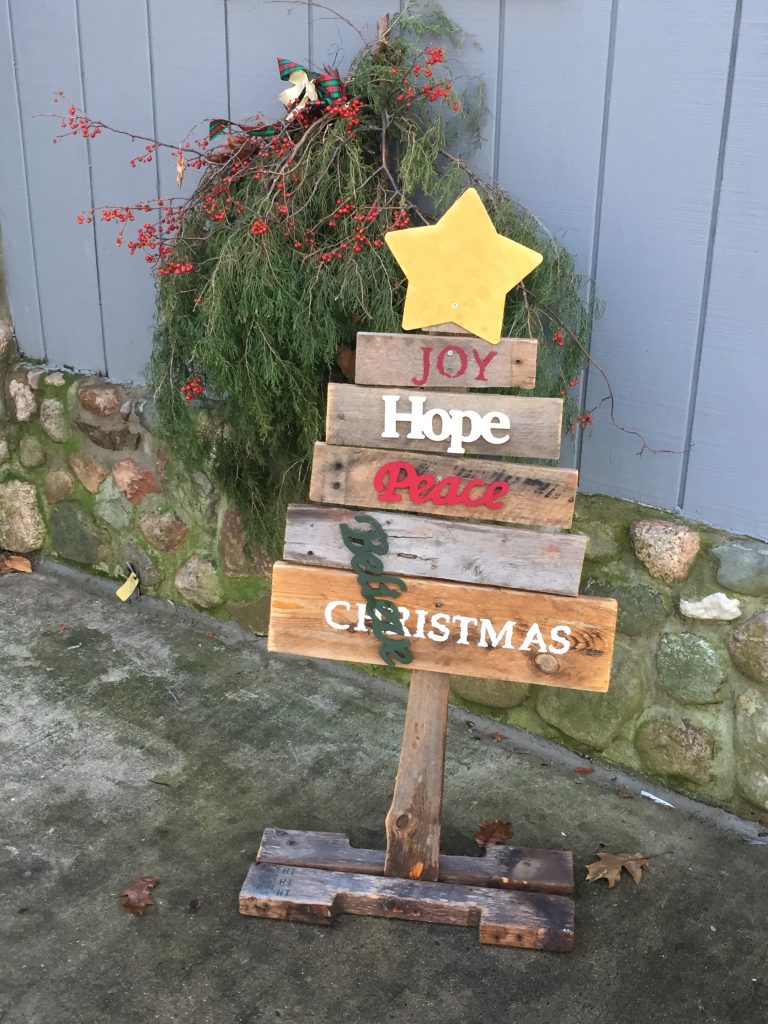
A Christmas gift from my youngest sister a few years ago claimed its place as a favorite holiday decoration ever since I received it. That may qualify as a minor Christmas miracle since I rate just a few steps to the left of Scrooge when it comes to holiday ornaments. The gift was a wooden tree with the words, joy, hope, peace, believe and Christmas spelled out on individual boards that represent the tree’s branches. Its simplicity and reminder of qualities I value earned it the honor of sitting on our front porch every Yuletide season since.
This year it once again took its place of prominence, greeting any guests who ventured down our driveway. Near the end of the season, as I drove up to our home I noticed the word “believe” was askew, dangling as though it was hanging on for dear life. “I guess it has been a tough year to believe,” I quipped. It struck me as a humorous comment until I realized there was a certain degree of truthfulness to the statement, for me at least. Perhaps there is for you as well.
In conversations with some of my friends, their lives have challenges but their faith is solid and their belief system is steady, seemingly untested. In contrast, for other friends life in general, indeed the foundation of society, is unraveling before their eyes as some combination of love, justice, integrity, or other elements important to their understanding of a faithful or at least tolerable world is being ignored, if not trampled. As is often the case I find both value and disconnect on each side of the discussion. What fascinates me in the thick of it all is that individuals who describe themselves as persons of faith, often the same faith, can be found at most points on the conversational continuum. These are sincere persons for whom beliefs frame their faith perspective and anchor their actions. Left within their own isolated circles, the risk is the creation of echo chambers that merely reinforce the prevailing point of view; but these days bringing contrasting views into the same circle has been more volatile that I remember from earlier days.
The apparent loss of civility during disagreements, negotiating tactics, and underlying motivations are unsettling for anyone who desires some sense of sanity and unity among us all. The fact that we can all trace our roots to points of commonality yet still represent such radically different points of view and motivations may well leave us shaking our heads in resignation as we consider fruitful ways forward. So yes, for me at least and many of us I suspect, it has been a challenging, if not difficult year for belief.
Belief seems not to be as important in this generation as it was in previous ones, or at least not in the same way that it once was. I have had numerous rich discussions about faith, religion, and spiritual practice characterized by fervor and commitment, but often without evincing much in terms essential touchstones or anchor points for belief. More times than not, when my fellow Quaker travelers are asked about beliefs or important theological statements that help describe them, the common denominator is some variation of the concept that “there is that of God in every person.” On the one hand that is a whale of a statement, but on the other hand, it says very little and raises more questions than it answers. I have not forgotten an enlightening conversation with a young man who described himself as an evangelical Christian but whose life gave witness to decisions I would not have normally associated with an evangelical belief system. I asked him to describe what was important in the practice of his faith. Without pause he answered: good teaching; fellowship; and accountability to those in his community. The possible sources of acceptable teaching were broad for him. The various networks for fellowship were diverse and global. Community included any he befriended and trusted. Completely absent from his list were statements about inerrancy of Scripture or blood atonement or the usual short list that has been historically included in a description of evangelical faith. I can appreciate that new description. I, too, care more about a faith that works its way into the very fabric of our existence rather than living primarily by a creed to be recited on demand.
As I ruminate on these experiences, I can only conclude that the belief system of our chosen community is ultimately filtered and interpreted within our respective contexts, then further refined by each of us individually as we choose what to keep, what to reject, and how to give witness to the things we hold as true. I can think of no better explanation for how good intentioned people read the same stories, hear the same teaching, and arrive at such different conclusions. How could the same set of teachings inspire radical hospitality in some and radical violence in others? Or result in inclusive and exclusive worldviews, each drawing on sacred texts found in the same book? Or produce extremism on both ends of the spectrum so that building a wall and erasing the boundaries are both seems a legitimate expressions of the same faith?
This gives me great pause as I wonder about our future. For from those same texts I find encouragement to work at reconciliation; but even that is complicated. Unless participants engage with an openness to imagine new possibilities, these efforts degenerate into labored conversations where one side seeks to wear down the other until weariness induces compromises that betray important values or severs itself completely from the group. For instance, I have observed several controversies where the anchoring values could be simplistically described as love vs. purity. Love exhorts us to accept and permit, whereas purity cannot do so without losing its integrity or redefining its litmus test. It is a nearly impossible impasse. Increasingly it seems that our commitment to group decisions, whether via democratic or church specific processes, is true only so long as our preferred position wins the decision. Seemingly absent is the ability to accept anything else as being for the common good, the will of God, or the leading of the Spirit.
One thing this multiplicity of interpretation highlights is that beneath the belief systems that guide us lays the equally important question of how we know when we are being directed by the Divine and when we are merely attributing our personal and socially influenced preferences to the Divine so as to add an air of authority to our point of view.
I feel a tinge of envy for those who are able to proceed as though all is right, or at least right enough, with the world. It may well be that they understand the secret to a happy life is to not worry, trusting that God will make a way through; and if not a way through, then at least make it right in the end. That seems to be easiest when the working definition of belief is assent to a set of statements or principles that provides clear guidelines for behavior and accepts that brokenness and injustice are part of this world and will remain so until creation is restored by a higher power.
While that reminds me a tiny bit of Moses’ words to the Hebrew people in Exodus 15 that the Lord would fight for them; they needed only to be still, I cannot silence those voices that call for us to care about the marginalized and oppressed. No doubt, this because of how my own beliefs have been assembled. When I accept that there is that of God in every person I find I must consider what truth their point of view may contain rather than dismiss it immediately. Even if I reject their viewpoint, that is different than rejecting them as a person. When I choose to believe that God blessed creation and called it good, I have to release the idea that evil could so incapacitate us that our God-given potential cannot prevail. Those two together leave me with an insanely irritating commitment to the idea that with God’s assistance we can be better than we have been if we can commit to living up to the measure of Light God has given us. While that welcomes multiple and diverse points of view into the conversation, it still does not necessarily aid our desires for unity, peace, and justice. It does not get us over the hump of our current global and societal disarray, precisely because while looking for guidance from the Light as we know it, we sometimes land in wildly different places. Building bridges between them is our only hope, but that requires a group effort that, to this point, seems impossible to facilitate.
A few years back, a friend of mine said he was not prepared to say that all truth was relative in spite of the cultural drift in that direction. He still clung to the idea that there were a few Absolute Truths. There were fewer of them than he had thought in his younger days. He was not sure that he could name them all, but he still believed they existed. I can appreciate that sentiment!
I have no trouble believing in God, though I have a basketful of lingering questions! As it turns out, my belief is most stretched by faith communities’ capability to hear clearly, act faithfully, and maintain integrity. Lest we are content with the life and habits of a spiritual hermit, we have our work cut out for us! As I choose to keep believing, I will need to continue pondering questions like these:
- Can we recognize any common ground that exists among us?
- Is any meaningful unity possible among diverse groups, and if so, how do we nurture it?
- Can faith motivated institutions pivot from obsolescence to relevance?
- Can new perspectives be welcomed without banishing completely existing values and commitments?

Back to the tree nearly losing its ability to believe–as I prepared to reattach the word believe to its designated branch, I realized the tree had come to the end of its days. Hope and peace slipped from their places into my hands as I picked up the tree. Joy drifted to the ground as well. The screws holding the individual branches stripped from their resting place, leaving me with a small pile of very dry wood. It made a nice fire that evening. The holidays will be decorated differently next year, but we will find other ways to let the Light shine. Hopefully, we will not be the only ones.

You must be logged in to post a comment.