
I have been thinking about purging my vocabulary. Think of it as a mental variation of spring cleaning. Like changing most habits, it takes a little effort. Usually the words under review are ones from my youth that no one in my adult world uses. Like “creamed” as a description of potatoes. Apparently most everyone else knows them as “mashed potatoes,” as I discovered upon arrival in Hoosier land.
The word I’m thinking of purging this week is one that was seldom used in daily conversations until recently. Like a family’s good china or a special bottle of wine, it was reserved for special occasions. The word is “unprecedented.” It has the potential to introduce surprising and novel experiences, like my first flight on an airplane. Up until that point in my personal life air travel was unknown. These days “unprecedented” is being used with, well, unprecedented frequency. News reports choose it to set an ominous or foreboding tone to their stories. Last Sunday a minister opened virtual worship by reminding viewers that we live in unprecedented times. I suppose it is true that never before could I participate in church as an adult wearing pajamas or going barefooted but I don’t think that was his point. The word is being used often enough that I finally had to stop and ask questions like,
- Is it true?
- Is it helpful?
- What are they actually trying to say?
- Is it “spin” designed to elicit a particular response?
There is probably not an easy answer to questions like those but they are worth pondering. I don’t know about you but I find I’m particularly sensitive to being manipulated these days. I’ve never cared for it, but I’m really on guard against it right now. That is part of what happens when trust between parties begins to evaporate, whether they be virtual or in the flesh.
From the standpoint of definition alone, “unprecedented” simply means something has never been done, known, or experienced before. Thankfully pandemics are rare but this is not the first time humanity has had its fruit basket turned upside down by an uncontrollable disease. So, it would seem right out of the gate that the use of “unprecedented” is questionable on a literal basis. That it is the first such experience in the lifetime of most of us may make it seem unprecedented, but in a historical sense it is not. If anything this is a reminder of the habit to limit our lens on reality to our particular time and experience when in fact we are small dots on an infinite time line. I might argue that a good number of our largest challenges result from that very thing—viewing the world’s problems and solutions only from the perspective of how they affect us personally and those near and dear to us.
If it is not true that this time is unprecedented, is it helpful to label it as such? I think the jury is divided on that. On the one hand hyperbole is an acceptable form of speech, assuming hearers know that its exaggerations are not to be taken literally. As such it adds emphasis and a bit of dramatic flair to the communication. Whenever I tell my wife that she’s exaggerating, her quick response is “I’ve told you a million times that I don’t do that.” There’s no winning that debate! If word choices like “unprecedented” are efforts to capture our attention to a particular moment in history that needs extra attention and care, then hyperbole may well be helpful; on the other hand, I have no reason to think it is being used intentionally in that manner unless I wish to give speakers the benefit of the doubt.
Given that most everything is politicized these days in the hopes of leveraging position and power (ah, manipulation raises its head once again), there is good reason to at least ask how tendencies to dramatize any issue are accompanied by ulterior motives. It is wise, crucial even, to be critically minded toward arguments on all sides of an issue because rarely, if ever, does one perspective have all the facts reasonably considered and interpreted. We owe it to ourselves and those whom we influence to be well-informed rather than jump on the first band wagon that comes along.
Here’s my most basic takeaway about the use of “unprecedented” to describe COVID-19. It means that even though this isn’t the world’s first pandemic, we can’t recall an experience like this one. We don’t recognize times like these. It is like driving through an unfamiliar neighborhood, not certain where are or where we are headed. Perhaps worst of all, we have no obvious solution and don’t know what to do. At a most basic level, our life and security feel threatened. “Unprecedented” gives us permission to be confused. It makes our fear seem reasonable. It grants freedom to deviate from accepted norms and try new things—which is important to do but also risky because we sometimes make poor choices under pressure.
Moments like these force us to face a truth that we’re often able to ignore in unthreatening times: we are not absolute masters of our destiny. We cannot control the universe around us. Never could, for that matter. How we respond when we know we’re not in charge reveals some the deepest truths about our character. Hoarding toilet paper is a funny example. Lashing out at Asians in our communities as though they are responsible for global havoc is a more depressing illustration. Whether we call it morals, social contract, or faithful living, now is a time when we discover how committed we are to those time honored convictions and principles that supposedly anchor our lives. How will they hold up? Do they need revision? Those are important questions not to be overlooked as we navigate these unusual moments.
Even though we have not been here before, shouldn’t we still have some confidence in and commitment to the type of people we imagine ourselves to be? If we have ever claimed to value integrity or fairness or love or justice, shouldn’t we still let those qualities shape our attitudes and guide our actions? (Of course, this logic breaks down if, at heart, we’re devoted to hatred, bigotry, and other harmful intentions!). If there was a way of living and relating that seemed well-grounded or divinely led before this, can we retain that commitment in our treatment of one another? It reminds me a bit of the advice investment managers give about staying the course with your investment plan rather than overreacting and changing course in the midst of chaotic times. Market fluctuation is gut-wrenching in the moment, but unless your needs or principles have changed, guarding against overreaction is prudent.
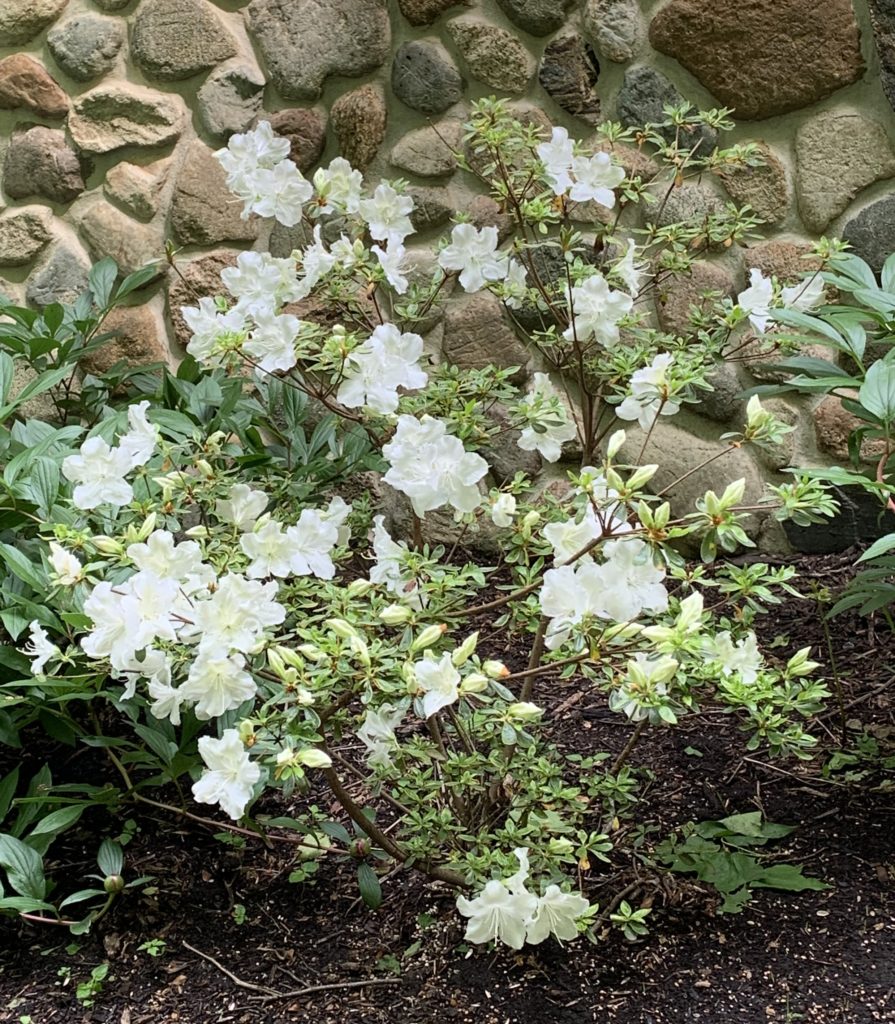
Here’s a less volatile experience as an example. A favorite part of springtime during my North Carolina years was watching the azaleas bloom. If you enjoy color, they are nothing short of spectacular at their peak. They set next year’s buds by the end of the season, like making hotel reservations for next year’s stay. Hearty enough to endure the winter in some climates, those buds slowly gain color as spring approaches, ending in an explosion of blooms so delicate that a hard downpour can pelt them all to the ground. But the few days they are in full color are worth the yearlong wait.
Within a few months of moving to Indiana I had to add azaleas to my list of “things I miss from N.C.” The climate was too cold for them to survive the winter, I was told. That didn’t stop local retailers from selling azaleas grown in hothouses every spring. Ever the optimist, the first few years I’d purchase one, enjoy it, and then plant it outside in hopes it would return next year. They never survived. About four springs ago, a trip to an advertised azalea garden on the western side of the state provided evidence that some varieties of azaleas could thrive here after all. With a new determination I began again. Three varieties have survived the winter in my location so far. Much to my surprise, among those are three white azaleas bought on clearance at K-Mart, of all places. Except for one problem–each one increased in size but they didn’t bloom the next year. Or the next. Azaleas without blooms are disappointing! I could find no guidance on the matter. Rather that dig them up immediately from the garden, I kept doing the only things I knew to do (which in some cases is a recipe for continued failure, I know). Sort of like when a child doesn’t become what the parent hoped they would, I accepted this different outcome and tried to appreciate them for what they were: nice, even attractive, green foliage that at least filled some space in the perennial bed by the house.
This spring, something must have changed. Maybe it was the cooler than usual spring. Or maybe they just needed a couple of years to develop. All I know is that on an afternoon walk in late April, I noticed plump white buds were beginning to swell. Just before Memorial Day, large white azalea blooms graced our garden. It is unprecedented! Maybe not worldwide. Maybe not in Indiana. Maybe not even in Wayne County. But it is unprecedented at my house – well, except for that time four years ago when they were blooming when I brought them home from the store.
Okay, so maybe it is not unprecedented, but it’s an unusual thing that I hope becomes an annual event. Time will tell. Meanwhile, it reminds me that when we live in moments in which we don’t know what else to do, remaining true to the bedrock of our character that commits to certain key standards of life and treatment of others is appropriate. Sometimes, that even creates an environment in which new beauty can flourish. As we wait and work to gain a surer footing in these uncertain times, may our commitment to what is right and true never appear to be unprecedented!

You must be logged in to post a comment.