
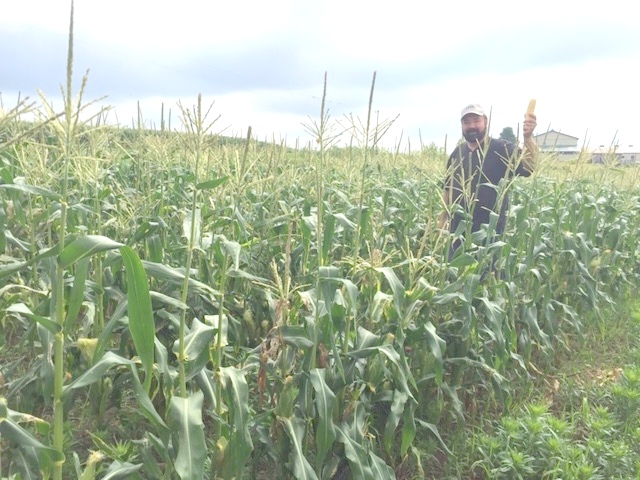
This has been the year of corn at our house. Vegetable gardening is a favorite summer activity of mine. After several years where one complication or another prevented growing a good sweet corn crop, that streak ended this summer. Judi and I have enjoyed fresh corn on the cob. We have frozen corn for use later in the year. We have included it in homemade vegetable soup, canned for the winter months. We have actually given more corn away to friends and neighbors than we have used for ourselves. A few days ago I returned from the garden with 263 ears of corn in tow. That was for one day of what has been about a two-week, 800 ears and counting, corn apocalypse! Most days even with the sweat bees swarming, I have been almost giddy at the bounty, enjoying the opportunity to share almost as much as consuming and preserving. For once, I have not even minded that a few deer and raccoons have feasted off our bounty. This whole experience has been a blessing.
The concept of blessing is one of those topics on my short list of “puzzles to ponder,” and it came to mind several times during this harvest. I do not really expect to resolve the questions attached to these puzzles, but from time to time I revisit them to think through the assumptions and beliefs attached to them. Picking and shucking corn allow ample time for reflection. I have long been fascinated with the theme of blessing. It first emerged in grad school, where I studied the concept of blessing as it developed in Old Testament theology. Firmly planted in the creation story in chapter one, the theme strongly influences the rest of Genesis and becomes one of the measuring sticks used to determine faithfulness in later books. My book Thanking and Blessing considers the value of a spirituality of gratitude. I much prefer a vision of God and creation where love and goodness contribute to blessing rather than one where judgment and division lead to hatred and chaos. Even so, blessing remains on my “puzzle list,” and here are some the reasons why.
It is popular to say “I am blessed” or “I feel blessed.” Those assessments generally reflect our sentiment that positive things are occurring for us, often interpreted as signs of divine favor. Numerous songs develop the theme that God blesses those whom God loves. Locate an old hymnal and hum along with “Count your Blessings” or “Showers of Blessings.” They were staples in the church of my childhood and I continue to be fond of them. Search YouTube and you will find more songs than you have time to play. “God’s Got a Blessing with your Name Written on It” or “Blessing on Blessing” are examples. The Bible’s portrayal of blessing, both material and spiritual, as signs of God’s favor is deeply planted in the Judeo-Christian tradition. The point is we have lots of encouragement to view good things happening to us as gifts from the divine. It is a perspective that has resonated with generations, and shows no sign of abating. For the record, I have no desire to discount or dismiss the value or the importance of that theme. I do, however, wonder if we become careless in the way we use the term. Once we assign responsibility for the perceived blessing to God, it is beyond critique or question. It insulates our assumptions against challenge, even if they are fraught with inaccuracies. It justifies the situation, even in the midst of suffering or injustices that might result from what we identify as a blessing.
Recently I viewed a video clip in which the speaker described how and why her school attempted to teach students about gratitude. I am a huge fan of taking the idea of gratitude seriously. It voices appreciation toward others who have contributed to our good experiences. The affirmation provided encourages the other and nurtures positive relations with them. Gratitude acknowledges that we alone are not solely responsible for our happiness and well-being. It helps us begin to see the way our lives are filled with blessings alongside the various trials and tribulations we encounter. Frankly, I think gratitude is transformational. Even so, the video clip gave me pause. The speaker acknowledged that her life was so blessed. I don’t doubt the truthfulness of her experience, but as she listed the things she considered blessings, I found myself interpreting the sense of her words to really, or at least equally, mean “I am so privileged.”
Funny how word meanings and usage can change over time. There was a day when the term privilege suggested “honor.” I am privileged to serve . . . I am privileged to introduce . . . I am privileged to accept . . . But these days, in some circles I travel, privilege is all about unfair advantage. Often the conversation connects with race, gender, or class. Maybe there should be a “God likes me better” group as well! In those conversations, no one really wants to be labeled as privileged and those who are often either feel bad or defensive about it (maybe both). It is an important, but complicated topic where unfortunately in many cases the extreme points of view dominate the conversation and talk past each other without hearing the kernels of truth expressed across the spectrum. But it does strike me as worth the effort to ask whether the things we may initially attribute to God’s favor might in fact be more complicated than that.
The video was useful because it encouraged me to think about if and how blessing and privilege are at odds with one another. Consider this year’s sweet corn experience. After years of no corn, this abundance easily seems like a blessing. It is, but is it due to divine favor or something else? In the sense that one thinks all good things come from God, surely it is. But did God single me out for this abundance this year? Maybe not, but still, what a blessing to have it, right? Perhaps it is less a matter of being singled out and more one of adequate warmth, plenty of sun, rain at the right times, and good soil – all forces beyond my control that came together to create a corn-ucopian extravaganza. I have long acknowledged that most of what makes a successful garden has little to do with me. I am mostly the hired help, the gopher, who goes for the seeds and battles the weeds and so forth. The wonders of germination, photosynthesis, and pollination are way beyond my pay grade! Still, I feel invested as a part of the process, and blessed when it goes well. I might even pat myself on the back for my labor, feel a sense of pride in “my garden,” and thereby give myself a little credit. It allows me to think that perhaps I earned a bit of that blessing, accidentally buying into the idea that God helps those who help themselves. But thinking a little farther, some of that breaks down. Gardening is second nature to me because of my cultural heritage. Not everyone has that advantage. Land is required. I own land that I purchased over time out of the proceeds of my earnings. Not everyone owns land, nor has the income to purchase it, nor could qualify for a loan. Could they be denied God’s blessing because of what they lack? And then there is the fact that this incredible looking corn was made possible because a friend shared his seed corn with me. Those who have no friends with access to corn might have difficulty in their own efforts. Before all is said and done, what is first described as blessing is a bit more complex than that. Knowledge plays a part, as does personal effort. Resources also contribute to the possibility. Connections grease the wheels. Gradually what comes into focus is that there are fine lines between blessing, being fortunate, and privilege.
Perhaps the bulk of the problem is that we have accepted a version of the Gospel that equates participating in the Kingdom of God with the expectation of prosperity and easy living rather than loving our neighbor, or doing justice, loving kindness and walking humbly. Or maybe in our sincere efforts to be thankful, we give God direct credit for everything because that is what we think we are supposed to do, when in fact that is not the correct, or at least not the complete, answer. While I am an advocate for a spirituality that embraces and notices divine presence in our world this new round of puzzling over the idea of blessing leaves me with a few conclusions for myself. Feel free to consider them for yourself if you find them helpful.
- I will try to view God as the center of my universe rather than myself as the center of God’s world. That is to say, I should know up front that it is not all about me. That is not to say that each one is not precious to God, but neither is God my personal candy machine.
- Divine love does not mean that God should or will give me every last thing I ask for. I can ask, seek, and knock, but frankly I do not always know how to pray. And if what I desire is bad for someone else whom God also loves, how is God to choose?
- If what feels like a blessing to me is hurtful to someone else, I should think carefully about how I speak about it. That is to say, I may feel blessed because the tornado missed my house, but if it wiped out my neighbor’s home, perhaps I should not claim God was responsible?!
- I will celebrate abundance when I have it and consider sharing it as I am able. Perhaps I am to be a conduit, not the final destination! After all, there is good biblical precedent for being a blessing to others.
- Innovation and effort are tremendous traits to claim, but we almost always stand on someone else’s shoulders. Humility is usually a better choice than arrogance and defiance that boast about God’s preferential treatment. The more we recognize our connectedness, perhaps the easier it is to share our bounty.
- Blessing is not to be equated with the acquisition of things. One valuable lesson from friendships with persons of different class and nations is their witness that joy and blessing are found among the poor as frequently (perhaps more frequently) as among the well-to-do. In fact, it may well be that in our weakness or lack we experience the most profound divine blessing.
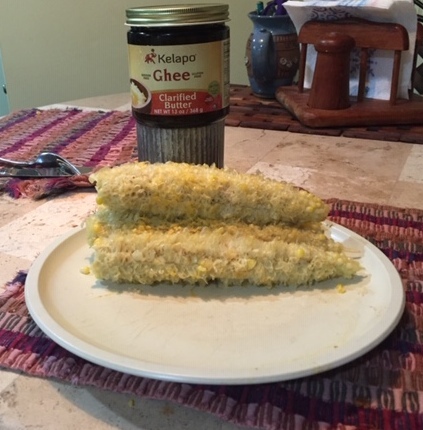
So it would seem, this year’s corn crop exceeded my expectations in more ways than one. I have about had my fill! Take what you like and leave the rest for someone else.

You must be logged in to post a comment.