
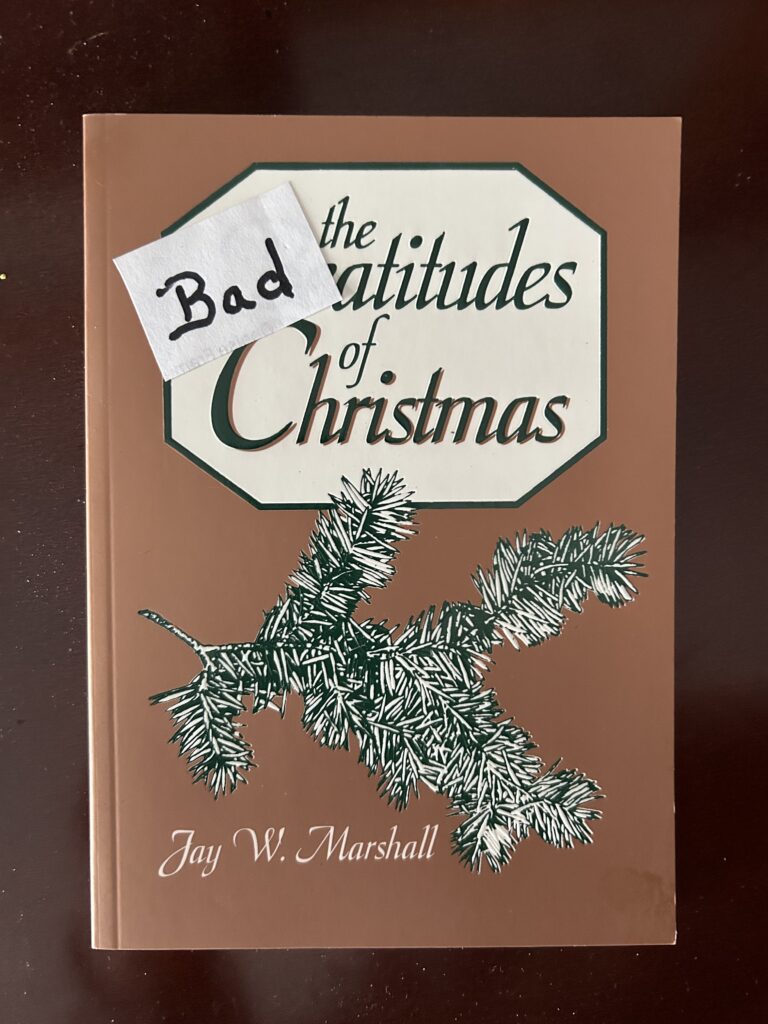
In 1996 a little book entitled The Beatitudes of Christmas burst onto the literary scene. I’d like to tell you it revolutionized the holidays, was adopted by Oprah, and spent months on the NYTimes best seller list. Instead, it was welcomed by a smaller but appreciative audience as it considered the warmest, fuzziest of Christian seasons through the more challenging lens of the Beatitudes.
Someone referenced that book in a recent conversation. That anyone remembers it after 29 years is a win in my thinking. My mind, which looks for any reason to chase an odd idea, blurted out, “Maybe I should write a sequel called “The Bad-attitudes of Christmas.” I doubt that I will, but that didn’t stop the idea from tumbling around for a few days. But if I were to do so, where to begin?
If I look in the mirror, a good beatitude-esque starting place might be “Blessed aren’t those who relish a curmudgeonly spirit.” Being a grumpy sourpuss isn’t typically my style, but it can be tempting during the holiday season. To be fair, curmudgeons are not without their useful characteristics. Count on them for a dose of skepticism, which is occasionally warranted. With the countless efforts to deceive or scam the innocent and naive, it pays to be apprehensive. I don’t have a grandson, so he can’t possibly be calling me for bail money. There is no good reason anyone from Nigeria should want to share their windfall wealth with me. I don’t even trust the “free” Walmart or Amazon gift card offer waiting for me in my email inbox. Curmudgeons are also quick to question authority or the status quo, usually with a critical or condescending tone that leaves little doubt of their true feelings. In an age filled with disinformation, knowing your sources are trustworthy has never been more important.
At their worst the curmudgeon degenerates into the Bah-Humbug world of Ebenezer Scrooge that is overly critical and inconsiderate. They have an amazing knack for squeezing the joy out of life for themselves and anyone they encounter. I overheard one last week while checking out a book at the library. A staff member admitted she didn’t care for the holidays and would be glad when they were over. “Why,” she asked, “do we spend so much time going places we don’t want to go just to spend time with people we don’t like?” I don’t claim to be a prophet, but I see a lump of coal in her future! However, I do understand the sentiment.
You’d think there shouldn’t be such a thing as too much cheerfulness, but occasionally I encounter people whose chipper personalities around holiday time push me near the edge. Honestly, can we only listen to Christmas music after Thanksgiving? And, traditions we had no voice in creating can carry so much weight it is nearly impossible to resist their pressure. I get it. If any of those leave you feeling empty it should be okay to ask “why” and find another way to spend your holiday — even if that means staying at home solo eating big bowls of ice cream in the dark. Whether at home alone or out on the town like the star attraction, avoid the curmudgeonly temptation to ruin it for those who are unfortunate to be enough to be stuck in your orbit while you are dominated by this sour attitude. After all, it is Christmas; and though it is difficult to believe, it is really not all about you!
“Blessed aren’t those possessed by an obsession with perfection.” So many subtle messages implant a drive deep within us to prove ourselves and be blemish free. Like avoiding any sign of red ink in the quest for a perfect score of 100 on school exams. Is 95 really such an embarrassment? Or my first-grade teacher’s demand that we stand before the class and announce whether or not we cleaned our plates at lunch. It was the final part of our weekly show-and-tell. It always felt like there was a little shame attached to not eating everything served; for me, that was tough the days we had pinto beans and turnip greens. They were my least favorite meal from an otherwise impressively tasty elementary school menu. To this day, as an act of defiance, I sometimes leave a partial bite or a few grains of rice on my plate and refuse to feel bad about it.
Messages to succeed and push ourselves profess to be good-intentioned and seem harmless enough. However, if we aren’t careful, a drive for excellence develops from “be better” to “be better than you.” Fast forward a couple of decades and we’re agonizing over how our Christmas decorations compare with our neighbors or enduring multiple retakes of a family holiday photo because one person’s hair is misplaced or a smile looks goofy or cousin Elmo stuck out his tongue just as the camera flashed. Meanwhile the whole focus on perfection builds stress for everyone involved until misery prevails and joy becomes a rare commodity.
A former colleague of mine observed that a student had perfectionist tendencies and a habit of overachieving in his class work: assignments were completed early and everything had to be error-free. The professor recognized this would work against the student in the long run. To help address the matter, the prof required the student to turn in one assignment late and with intentional errors. The sooner he released himself from an unattainable standard, the better his chance to flourish. I’d wager that is true for most of us. There is certainly nothing wrong with putting your best self forward in the celebration of Christmas, or just basic life itself. But ease up a bit if perfectionism dominates your day. Life is not a competition. Christmas is more about love and gratitude than exceptionalism.
“Blessed aren’t those who use Christmas goodwill to assuage their consciences after eleven months of neglect.” One of the things I like most about Christmas is the outpouring of generosity for projects designed to help others. For a few weeks much of the world seems like a happier place thanks to the kindness and compassion that appear to come so easily. Perhaps it is providing families with a food basket so they have the kind of holiday feast many of us take for granted. Or an Angel Tree, where people choose a family’s name from a tree and provide gifts according to the suggestions given. We experience the joy of philanthropy, whether great or small. It doesfeel good to do something for others, and doing something is better than nothing. But it occurs to me that after providing one holiday meal, there are1094 other meals needed in the year. Where is that goodwill during all that time? Have we really made a difference in that person’s life? What else might we do? Of course, the beatitudes do say “Blessed are the poor.” Might we deprive them of God’s blessing if we interfere too much with their condition? (sarcasm in case you missed it). Does the one meal console those who are down on their luck? Or would it have the opposite effect of highlighting the fact that we mostly ignore the down-trodden the rest of the time?
One year I spearheaded an effort to purchase a goat for every family in a village in Rwanda. Those animals were an important part of a family’s economic capacity. It was exciting to imagine helping a whole village take a step forward together. When I visited them several months later, some of the recipients walked up to 10 miles, accompanied by their goats on leashes. They wanted to say “thank you.” I have never felt more gratitude expressed toward me than on that day; at the same time there were numerous signs that it was such a tiny drop in the bucket, one could wonder if it would have any long-term impact at all. Questions like that gnaw on me whenever I consider contributions to good causes. Is this gift going to make a difference, or am I mostly giving to atone for my neglect the rest of the year? In no way is this to discourage us from getting involved! If anything, it hopes for the opposite effect.
“Blessed aren’t those who confuse gift-giving (or receiving) with the good news that matters most.” Gift-giving is a central part of the Christmas season. It is tempting to blame this on the wise men who set a precedent by bringing gifts on the first Christmas. They, in turn, would likely blame the pagan holiday Saturnalia whose gift-giving and use of greenery in its festivities is thought by some to have influenced our Christmas celebrations. Some of my best Yuletide memories involve massive hauls of gifts from family, mostly parents, who went out of their way to make sure we four kids weren’t disappointed. I love those memories and appreciate their sacrifices to create the experience. I suppose I shouldn’t object to a practice that spreads goodwill — and for that matter, props up the American economy. Retailers reportedly do 30% of their business during holidays and purchases during that period account for 70% of the US GDP.
Unleashed without restraint however, the practice of gift exchanges fuels greed within the recipient’s heart for more, or encourages unreasonable debt to finance the occasion, or misdirects our attention away from a celebration of the Christ child. At that point, it may qualify for the Bad-attitude of Christmas list. It is one of the major influences in the shift from Christmas as a Holy Day to simply a holiday. Interestingly, Christmas is about gift receiving, but that which God has given, rather than what is boxed and wrapped under the tree.
If this reflection unearths any bad-attitudes that merit a place on the list, send them my way. This may be the start of a whole new version of a naughty list at Christmas!
