
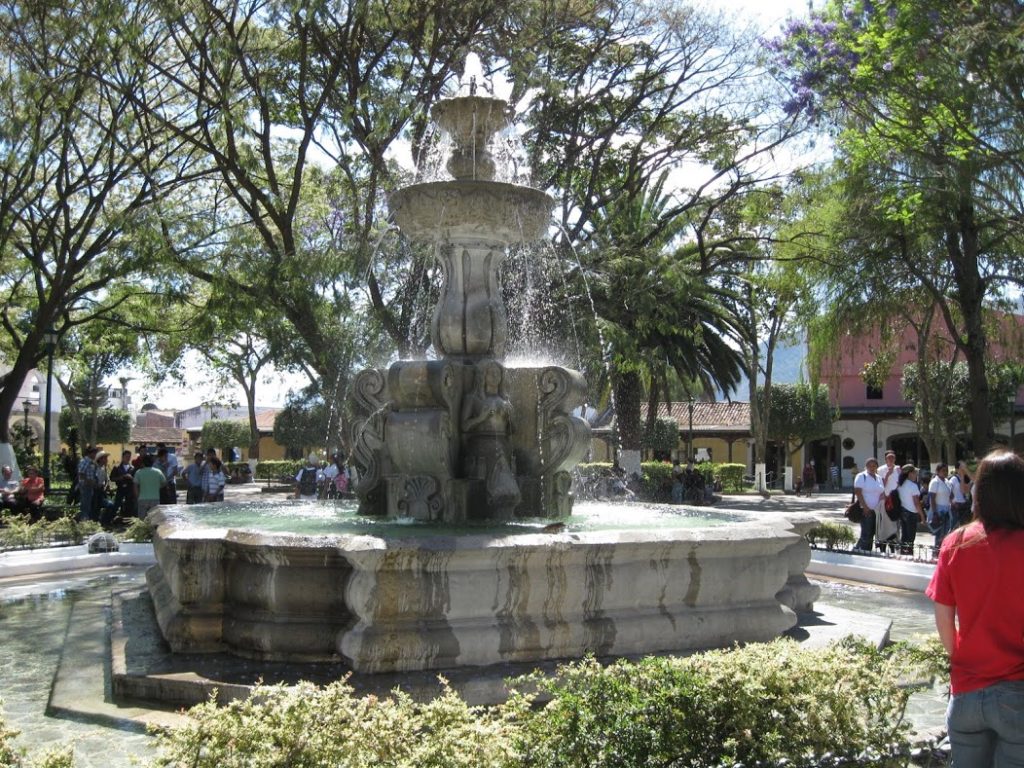
I cannot recall visiting any city in Central America that does not have a central plaza at its hub. Often occupying an entire city block, these plazas are usually lush with trees, ample shade, benches and a decorative fountain. It is the kind of setting that invites a person to linger, and so they do! People of all ages gather, especially in the evenings. Elders play games. Youngsters race and dance. Teenagers test young love. Vendors populate the sidewalks, taking advantage of the foot traffic and ambiance. However difficult the day has been and however dangerous the city is by reputation or in truth, people gather. They relax, and the whole area hums with the exuberant energy of life. I love to park myself on a bench and watch the gamut of emotions expressed as life transpires.
There were not any “no loitering” signs posted. Law enforcement, while often present, did not herd the people along or insist they take their conversations elsewhere. This was space designed to welcome and hold its guests so that community could be built. It is a piece of Central American life that I have often wished could be nurtured in places I have lived. That setting surfaced in my mind this week as I reflected on words I read from the Old Testament prophet Zechariah:
This is what the Lord Almighty says, “Once again men and women of ripe old age will sit in the streets of Jerusalem, each of them with cane in hand because of their age. The city streets will be filled with boys and girls playing there.”
Zechariah 8:4-5
I had to wonder, what would be required for those words to be actualized? I think it would imply that an ethos of peace and tranquility prevailed enough that people had the opportunity to grow old rather than be mowed down by violence and recklessness in the prime of their lives. And having reached that ripe age where mobility was in decline, they still felt safe enough to toddle down the street to a favorite bench or coffee shop, meet their friends, and visit for a spell. It would mean that children’s joy had not been snuffed out by abuse or fear, and their nearly inextinguishable light could animate a neighborhood. Given the chance, they would play for hours with their friends, not returning home until called for dinner; and parents had enough confidence in their children’s safety that they need not worry or fret about the decision to allow them to play outside of their supervision. That description is not far removed from the world I knew as a child. While being southern and rural had its own stigma in some circles, I recognize the privilege it also held: peace; relative safety; a trustworthy community that probably gossiped about the neighbors but most of whom were equally quick to lend a hand when needed; a stable nuclear family. It wasn’t a perfect world by any means, but school shootings and bombings of various houses of worship were not a regular feature on the nightly news. Many, many places have rarely known that kind of stability, whereas I grew up thinking that was how life should be. I still see glimpses of it here and there, but I hear and read that it is missing in too many places!
I don’t know if the world is actually more disrupted these days, or we simply know more about it thanks to social media and the 24-hour news cycle. In either case, I am more aware of the chaos than before. Even the small town near me had an active shooter incident in one of its schools recently. In addition to the tragedy of that event itself, I watched parents’ anxiety escalate as they sent their children off to school the next day, now knowing that they were not immune from random acts of violence.
The Zechariah passage I referenced earlier wraps its vision of the tranquil community within a larger expectation of restoration. Within that description, society’s role was spelled out simply:
“These are the things you are to do. Speak the truth to each other, and render true and sound judgment in your courts; do not plot evil against each other, and do not love to swear falsely. I hate all this,” declares the Lord.
Zechariah 8:16-17
There, it seems to me, is one of the rubs—a huge obstacle working against the possibility of relaxed elders and playful children. Somehow, much of our society acts as though deception, intimidation, and exploitation are the pillars of negotiation; truth is optional so long as your spin on the story is convincing. This is not limited to a few misguided individuals; it has somehow settled into the very systems and structures designed to support and sustain us. It is often visible in international negotiations. It is not uncommon in local politics. It rears its head in cutthroat business practices, such as deceitful advertising. It even influences the way neighbors and families approach their disagreements. Leverage, power, and greed, are permitted to provide advantage to some—which means others are simultaneously disadvantaged and will eventually look for ways to rectify that situation–which means the central plaza becomes a riskier venture.
Perhaps it has always been that way. When the dominant narrative of many inspiring success stories is peeled away, one frequently finds a less flattering thread or two that is conveniently overlooked or perhaps not even recognized. Thankfully, it is not always the case, but moving away from this ingrained tendency requires intention to represent a different set of values and a commitment to consider more than one’s personal gain. On occasion, I have tested a different approach to see what might prevail.
For reasons unknown to me, I enjoy handwoven carpets. This fascination began after seeing a presentation in Turkey that explained the process and the extraordinary handiwork required. Introductions to some of the workers plus conversations about working conditions and child labor were important parts of the visit; as you might imagine, exploitation is commonplace in some of these industries.
A few years later a tour in Morocco included a stop at a local carpet shop where, after the usual presentation and hot beverage I was ambling around the shop admiring the patterns and colors while waiting for the tour guide’s call to the bus. No one browses alone in these shops–at least not for long! Soon, a salesperson approached and the banter began.
“You have an excellent eye. (Flattery) This is a fine selection. (Wouldn’t he say that about them all?!),” he said.
“Yes, it is nice, but I am not really in the market for a new carpet,” I answered.
“My best customers are those who insist they are not looking for one. Make me an offer.” he suggested.
“I really can’t,” I answered. “I have no idea of the cost of materials, of the hours of labor required, of the overhead costs. I haven’t a clue as to what a reasonable price would be. I wouldn’t know where to begin.”
He insisted, “Just make me an offer. I am sure we can find an acceptable price.”
“No doubt we could; but how would I know if it is a fair price?” I responded.
“Trust me. I will give you a good deal.” he promised.
We played through a few rounds of this kind of conversation. After a point I said, “Look. I do like the carpet, but here’s the thing. I don’t have the information I need to make an informed offer. What I want is the cheapest price I can get that is also a just price for you. I have no desire for you to lose money on this deal because you need to earn a living, but neither do I want to be taken advantage of by being gouged by you due to my ignorance. If you really want to sell me this carpet, here is what I would be willing to do. I want your absolute best, just price. My religious tradition has a long commitment to set prices and economic integrity. So, you get one chance to price this carpet for me. You tell me the lowest price you are willing to take that is also fair to you. I promise you I will respect your judgment. I will either accept the price or reject it, but I will not counter with a lower offer. If the price is one that feels comfortable to me, given that I don’t know what this carpet is worth, I’ll take it. If it seems too high for my budget, we will go our separate ways.”
The salesman looked at me as though I came from another world. (Perhaps in some ways, I do!) He thought about my request for a few moments and named a single price that suited my conscience. I enjoy this carpet every day when I sit in my living room. About once a year I receive a phone call from Ibrahim who tells me he is in the U.S. selling carpets at one venue or another, and wonders if he could come by my home to show me his collection. To this date, I have always declined. It is important to know the difference between friendship and sales!
I have valued that experience with Ibrahim almost as much as the carpet itself. Admittedly, I still do not know if I received a fair deal. I do know it cost less than others were paying for similar carpets that day, and less than I have paid for carpets in previous barter situations. More importantly for me, this was an opportunity to challenge a traditional model in which a legitimate need to make a sale is often corrupted by additional layers of deception and pressure—a manner of engaging others that I find difficult to justify.
Admittedly, this was one small conversation but I like to believe that this kind of effort to recast our interactions with others has much to offer our attempts to live together in this small world and even tinier neighborhoods. When we can meet the other with honesty and fairness, we may be able to revise the ground rules of our exchanges. Encouraging a move away from seeing our engagement as a transaction from which we alone should profit, toward a relationship that promotes mutual value and respect for each one involved represents a seismic shift. It lays the kind of foundation that can nurture positive, ongoing relationships and draws people to form their own central plazas where relationships flourish, both personal and professional.
I do not suppose I will see a literal central plaza spring up in the little Midwestern village near where I live. But wherever we live, perhaps we could work on discovering other ways to create ample areas where playful childhoods, wise elders, and welcoming spaces indicate we are succeeding in the creation of a mutually respectful community.

You must be logged in to post a comment.