
The road to hell is paved with chip and seal. At least that is my hunch.
That statement, or course, is a play on the old saying, “The road to hell is paved with good intentions.” I take that to mean that many good thoughts and plans never become reality, and without their contribution to the flow of things, many good ideas never come to fruition. Meaning well, by itself, isn’t enough.
I think some version of that adage is a built-in component of road maintenance in Indiana. Perhaps I should modify the saying to read “The road to almost anywhere in Indiana is paved with chip and seal.” With that I don’t mean to swap Indiana and hell as though they are interchangeable. But if the desire of road repair is to create a satisfactorily improved travel experience, then we may have missed the mark. No doubt, the planners meant well. They even executed, which usually doesn’t happen on this imaginary road to hell. But the adopted plan failed to deliver lasting, desired results.
A short trip to Michigan convinced me it doesn’t have to be that way. It left me envious with regard to state roadways. Smooth. Well-maintained. No cracks or potholes. Perhaps Google Maps only routes visitors to the best roads? We journeyed from the southern border all the way to Marquette in the Upper Peninsula and back. It left me dreaming of what it might be like to live in such a place where roadways were inviting, like friends welcoming us into their homes.
Around these parts, Summer is the season of picnics, long days by the pool, and of course, road construction barrels signaling major construction projects. But that is just the beginning. Summer is also a season of minor road repair. Although I hate slowed and stopped traffic due to road construction, I do appreciate well-kept highways and that is the price we must pay. Good roads are worth the wait time in construction — eventually. But that doesn’t mean it is easy to endure!
Personally, I wish the world’s roads were paved with nice, smooth asphalt that could last a lifetime, if such a product exists. Alas, here in rural Indiana we are usually treated to regular diets of a process known as chip-and-seal road repair. If you have been blessed to not know of it, for the sake of understanding, here is brief description. Hot tar or a thin coat of asphalt is put down and then covered with an aggregate material that is basically a layer of small gravel. The theory is that the gravel bonds to the tar, which itself is bonding to the old road surface. It is reportedly more economical than some other options, and I’m guessing that is a major reason for its frequent usage. Faster to complete, simpler to put down, and cheaper on the old government purse. What’s not to love? But before you declare your allegiance to this choice, remember the last time you skimped on quality. Say, the time you bought cheap paper towels or toilet paper to save a couple of bucks, only to regret it as soon as you put it to use. Or when you opted for a Ford Pinto rather than a Ford Mustang. Both cars are made by the same company. Both named after a horse (or maybe one is a bean!). Both provide transportation. How different can they be? Today one is iconic and the other is not so much. Cost saving is never the only factor to consider.
For now, and likely for the foreseeable future, we endure summers of chip and seal. Therefore, in the spirit of the Boy Scout motto, “Be prepared.” (Why do I still remember that?) Know that vehicles that pass over freshly sealed roads can expect to hear the sound of gravel being thrown up on its undercarriage for a few days. Some of it will stick to your car because the tar hasn’t yet cooled. Occasionally it sticks in wheel wells or even on the painted surface of your otherwise spotless vehicle. You’ll then have the option of living with it or applying a little tar remover and elbow grease to remove it. The damage is minor, though irritating nonetheless; but this reflection was prompted more by my experience as a bicyclist than a motorist.
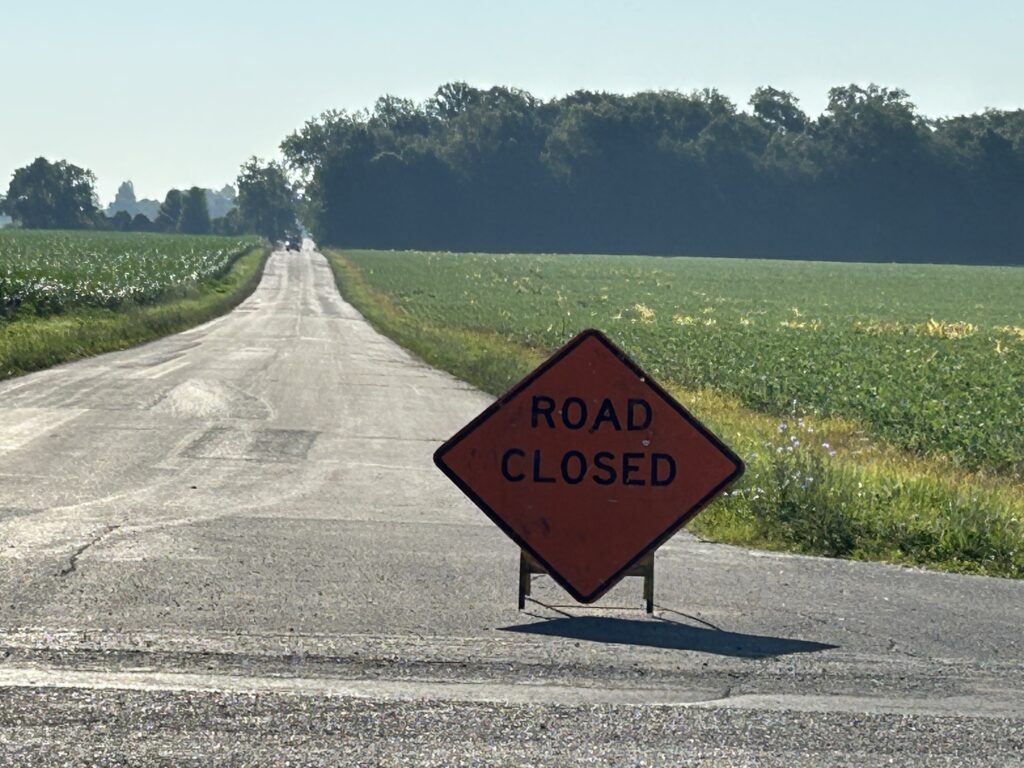
On a recent bike outing, we set out for a destination about twelve miles away. Two miles up the road we encountered a road closed sign that hadn’t been there the day before. Turns out, the highway department was applying patches of chip and seal. Not to be deterred, we calculated a new route, turned left at the next intersection and proceeded toward our destination. Two and a half miles later, we prepared to turn right for the next leg of the journey – only to find an orange diamond shaped sign in the middle of the road. It’s message? Road closed! This happened a couple of more times on this single outing, but with determination, we eventually made it to our destination.
To be clear, I value good roads. I have been in a few countries where motorists preferred to drive on the sides of the road rather than on the actual road itself because the roadside had smaller potholes than the pavement! I appreciate what we have even if I grumble a bit. The workers I meet along the roads are friendly and considerate. I admire their commitment and absolutely do not want to complicate their efforts by being in the wrong place at the wrong time. Our quality of life depends, in part, on their success.
My gripe is not about workers. It is not about the road closures, though a little advance notice would be nice. With social media, how hard would it be to list the day’s work zones? More than the inconvenience, my frustration comes from the fact that riding a bike on chip and seal can be perilous. The loose gravel left over after the process (which may eventually be swept) can easily throw a bike. The tires of oncoming traffic pick up loose gravel and sling it at oncoming vehicles. On that ride three zingers pinged my arm, leg, and cheek as I pedaled passed traffic. Even at its best, a chip-and-seal road gives a rough ride to bicyclists. Worst of all, these roads crack in a short time. In a car, the crack causes a regular sound of womp, womp, womp, which isn’t a rhythm you want to dance to, but it is tolerable. On a bike, it is far worse; the impact created as tires roll across the crack nearly jars your back molars out of your mouth and leaves you with a mild headache.
As I think of these chip and seal experiences, my gripes remind me to look beyond the present irritation. For starters, it seems important to remember that someone shouldn’t be faulted for their good intentions. Intentions are motivated by values supported by our character and deeper commitments. Not only transportation, but also community connectedness, benefit from our road system. I believe the highway department means well in their efforts to maintain it. They do the best they can with the material provided. Good intentions should be respected; however, failure to follow through or improve performance through regular evaluation may well deserve a critique.
Likewise, I can work to appreciate that though the current practices are problematic, I would choose our aggravating pavement over dirt or gravel roads. Cracks may be preferable to potholes, though it is really a coin toss after a while. But somewhere up the food chain where decisions are made, could we not research for a better solution? Maybe talk to our neighbors in Michigan about their practices, since they seem to have figured these things out?
I suppose no road to hell would be a pleasant journey, but chip and seal just guarantees there will probably be detours along the way, and it won’t be smooth ride. Truthfully, life is sometimes bumpy. Not every road is smooth. Not every journey is pleasant. No all repairs get us to back to where we once were or where we want to be. As long as we are able to keep going, perhaps it is best if we worry less about the chip and seal and simply be grateful to be able to ride at all.
