
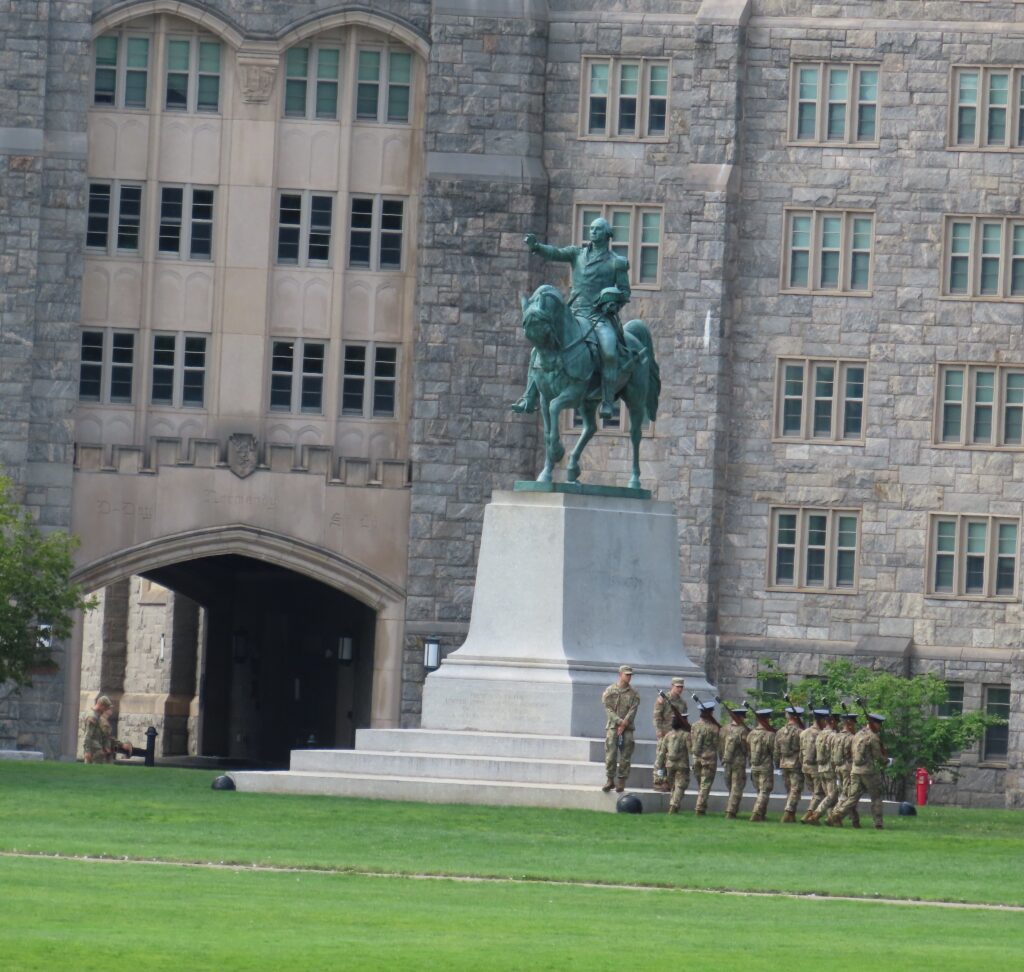
A lazy cruise up the Hudson River included a visit to West Point, or the United States Military Academy, to be specific. Established in 1802, at least one reason for its selection was the strategic location it provided for defense of the area. It was mentioned several times during a recent re-watching of the mini-series North and South as young men aspired to go there, in part to make their own way in life and in part for military training. Because of that, the place had recently been on my mind.
West Point remains an active institution for military leadership development to this day. As we sat in the bleachers that morning near a training field listening to our guide, a helicopter carrying a high-ranking military official departed, probably no more than 100 yards away. I couldn’t help but wonder what was going on behind the scenes and how would it affect our country. Of course, I don’t have security clearance for that information!
During the guided tour of the grounds, our leader reflected on the goals and formation of cadets who prepare for service there. “Loyalty” was one word she used to describe the foundation of their philosophy. However, she was quick to clarify her intent. Through training and living together, a tremendous camaraderie develops within the group. They become like a family who can be trusted, even under fire. But a strong code exists underneath that unity. It can be expressed in a single sentence: “A Cadet will not lie, cheat, steal, or tolerate those who do.” Great emphasis is placed on the “tolerate” portion of the code. That is to say, cadets are not only expected to live by the code; they are also required to report any infractions they witness. Failure to do so is itself a violation of the code.
Try placing that standard to not tolerate alongside the allegiance a cadet has to the company! Various groups with strong ties reportedly have unwritten rules about snitches. In general, it doesn’t go well for them! A little tension between the code and the bonds of camaraderie is inevitable, giving birth to a few questions. How many loyalties might a person have? How are they to be prioritized?
Our guide was absolutely clear. A cadet’s primary loyalty was not to a buddy or fellow soldier, however important that relationship might be; their primary loyalty was to the Constitution and its nation, period. Not any specific party. Not a particular leader. Not a best friend. I can appreciate that level of commitment. It reminds me of the expectations that accompany faithfulness in Christianity, at least as I understand it. Our loyalty is to a higher power than a congregation, minister, or even denomination. The “no tolerance” piece of the conversation may be tricky at times, but prophetic ministry can easily provide a connection point for that theme.
The tour was brief, but long enough to stimulate a bit of reflection on loyalty. It reminded me of the concept of “loyalty points” which businesses frequently award their customers. When I need gasoline, my first impulse is to look for a Speedway station. Why? Not because their gas is better or the facility is cleaner. It is because they give me a 5-cent per gallon discount and points for my loyalty. I appreciate the price reduction most of all, but those points also can be redeemed for other items as certain point levels are achieved. In short, my loyalty is being bought. It is no real sacrifice for the company. They’re imprinting their brand and reinforcing my habitual purchase of their product. But if a better deal came along, how long would I remain their customer? The truth is that when it comes to gasoline, I’m still primarily loyal to myself.
Similarly, travel companies offer points or even dollars in the form of travel credits in return for previous travel with them. Just this week I stewed over possible trip options by next April because $1033 of credit would expire after that date. The awarding of that money cultivates a loyalty to their company and the product they offer, even though I’m sure the potential reduction is already built into the trip price. Its purpose is to lure me to spend money once again in order to get the benefit of the credit. If it is somewhere I want to go, the credit is not without value, but it is not quite the altruistic gift that it initially appears to be.
Not all loyalty has profit and success as its core motive. When I was a teenager, I occasionally worked on odd jobs for a local company. One day the owner paired me with another slightly older man whom I’d never met before. We were to retrieve a fuel oil tank from the premises of a former customer. As we worked that morning, my partner and I began to get acquainted over small talk. At some point he asked me, “You’re Wade Marshall’s grandson, aren’t you?” I answered in the affirmative. He proceeded to tell me stories of how my grandfather had been helpful to his family through the years. Perhaps by giving them work. Or food. Or a reference. He ended by professing a loyalty to my grandfather. That was all news to me, but the bigger surprise was that he transferred that loyalty to me, saying, “If there is ever anything you need, just ask. If there’s any way I can help, I will.” I never put that offer to the test, but neither have I ever forgotten it.
Soundbites and easy quotes about loyalty are “all over the map,” as they say. Some lean toward supporting friendship regardless of the circumstances; others bend toward remaining true to principles and virtues over the expectations of others. And, some recognize loyalty can be blind and self-defeating.
- “What I value most in my friends is loyalty.” – David Mamet[1]
- “Speaking truth to power is actually a form of loyalty.” -Richard Haas[2]
- “Loyalty to petrified opinion never yet broke a chain or freed a human soul.” – Mark Twain[3]
for good or not, I am of the mind that a better brand of loyalty is not bought, but earned. It isn’t the result of mutually beneficial transactions, but the response to presence and action that adheres to a higher code and maintains its commitment through thick and thin. At its best, it certainly provides an invaluable support, but never turns a blind eye, or presumes it should trump bad behavior. Simply stated, in its better, higher manifestations, loyalty presents itself in devotion and commitment, undergirded by trust. It creates faithfulness to a cause or ideal, placing its success over one’s own personal aspirations. It may well be the kind of ideal expressed by our guide at West Point, but unfortunately, I think we are probably in the minority. Which leads me to another soundbite kind of quote:
“Unless someone like you cares a whole awful lot, nothing is going to get better, It’s not.” – Dr. Seuss[4]
[1] https://www.brainyquote.com/topics/loyalty-quotes, accessed 9/5/2025
[2] https://www.brainyquote.com/topics/loyalty-quotes, accessed 9/5/2025
[3] https://www.brainyquote.com/topics/loyalty-quotes, accessed 9/5/2025
[4] https://www.brainyquote.com/topics/loyalty-quotes, accessed 9/5/2025
