
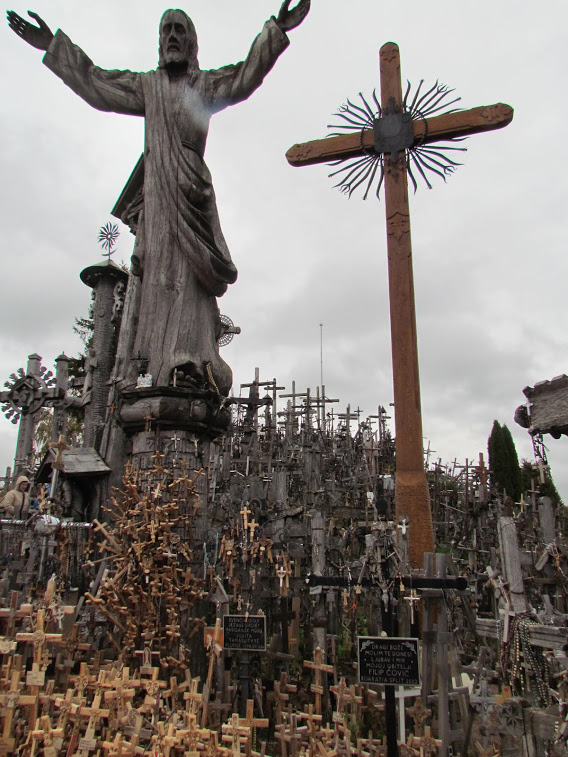
There were literally thousands of them. Some towered several feet in the air. Others could have been carried by the hand of a small child. The area was crowded with crosses, with no particular order evident except to allow for footpaths through the space. Over 100,000 crosses stood on this hill, each one occupying a spot; each one representing a life, a story, a dream that someone wanted remembered. This was my impression of a visit to the Hill of Crosses, which was on a recent itinerary of mine.
The Hill of Crosses is a pilgrimage site located in Lithuania. The stories attached to each individual cross make it a special place for those who add their contribution to the site. Each cross represents a life that mattered to someone. Standing alongside so many others helps insure that it will not be forgotten even as it loses part of its own individuality once it is placed among the group and becomes one among many. Creating a pilgrimage site was probably not on the minds of those who placed the first few crosses there. As I listened to its history, it struck me as an act of witness and resistance. Witness to the loss of someone important; and resistance against forces that sought to silence and eradicate a culture and a religion in the effort to occupy and dominate a territory.
One piece of information that weighed heavily on my heart even before encountering the hill was the fact that for much of their history and particularly most of the last two hundred years up until the dissolving of the Soviet Union, Lithuanians were exiled, occupied, or ruled by someone else. That bit of history was already churning within me, causing me to wonder what it would be like to live under foreign occupation, have my land stripped away, and even have my citizenship revoked because the country itself was no longer recognized as a sovereign state. The plight of Native Americans and even the Reconstruction Era came to mind as potential examples of similar sorrowful experiences involving my homeland. I will admit to being grateful for being removed from these incidents directly, but they do add to a nagging question of “Why is it that so many tribes and nations are not happy unless they are oppressing someone else for their own gain?” That is the kind of query that sobers the moment, but the story of the origin of the Hill of Crosses counters that dulled mood with a bit of realistic inspiration.
Tradition says the first crosses appeared back in the 1830’s during an uprising against Russian oppression. Some people went off to fight in the rebellion, never to return. Others mysteriously disappeared, possibly kidnapped and removed from the area, leaving distraught family members to speculate about their fate. Within those uncertain times as a new regime sought to squelch dissent and intimidate opposition, a few found a quiet way to commemorate their losses. They peacefully erected crosses on the hill to remember those who were missing.
The use of a Christian symbol for remembrance was, in itself, an act of resistance against a movement that sought to silence religious expression. During the mid to late 20th century under Soviet occupation, the hill became a more important site as a symbol of resistance as the Lithuanians sought to protect their heritage, religion, and identity against the efforts to create a more singular identity within the Soviet empire. Apparently the hill’s uniting power was a nuisance to the oppressors because they bulldozed the site three times, but it always returned! They reportedly planned to create a reservoir there so that the whole site would be underwater. Fortunately that never happened.
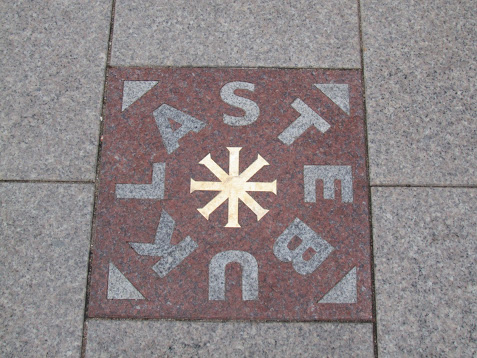
Our visit to the Baltic Capitals was filled with stories and images of resistance and survival. In the city of Vilnius, we stood on the plaza marked by a commemorative tile identifying the ending point of a human chain that extended from there through Riga, Latvia to Tallinn, Estonia. Two million people stretched almost four hundred twenty miles as a demonstration for independence. (Read more about it here: http://www.thebalticway.eu/en/history/). Our guide shared with us her own experience of joy the day she was finally able to trade her Soviet issued documents for a passport identifying her once again as a Lithuanian. A ninety-two year old woman described her living conditions the years she was taken from her home and exiled to a labor camp in Siberia until she convinced the driver of a supply truck to allow her to stowaway in his vehicle as he exited the compound. We had lunch in the home of a family with a small fruit wine-making business that had managed to retain a portion of their property by burying the family silver and replacing curtains with burlap so that they were not judged to be among the elite. (To this day, later generations of the family have not discovered where exactly the silver is buried!)
This region is full of stories of witness and resilience. These days, I find those to be two admirable qualities. Witness, because our lives cannot help but testify to the things we value. How nice it is when our living matches the things we say we are important to us! I have come to believe that alignment of our life and our values is a key to faithfulness as well as to happiness. Resilience, because it keeps hope alive in the face of opposition. In my travels, I have stood on the grounds where some of the worst atrocities heaped by one group upon another have occurred, learning of them in a way that simply reading a book cannot convey: the beaches of Normandy, mass grave sites in Cambodia, concentration camps in Poland, a genocide museum in Rwanda, to name a few. Each of those places shows evidence of recovery and continuation, though not without costs and scars that document the pain. Humanity’s capacity to inflict suffering on others is matched only by the resilience of the human spirit. Time and time again, hope persists among those who survive. Like a dandelion pushing its way through a parking lot crack, resilience means we continue to be drawn toward and push to the Light even in difficult circumstances.
I appreciate the stories of these Lithuanian friends and many others. They remind me that sometimes we only see the value of the life we enjoy when it comes under threat. That feels more important to me as I struggle to understand the divisiveness, globally and locally, that seems more volatile than before.
These stories demonstrate that witness is important if the life you value comes under siege, and is not to be obliterated and forgotten. If only we could manage to resist with peaceful strategies like the ones exhibited here before resorting to violent ones.
And perhaps most importantly, they remind me that no matter how bleak the moment is, resistance is not futile, after all. That is the sort of advice that is worth tucking away in a place where it is not easily forgotten!

You must be logged in to post a comment.