
Christmas in Mexico pretty much guarantees the holidays will not be snow-covered, but there is plenty of cheer to enjoyed nonetheless. This year we headed to the Southern part of the country — first Oaxaca, then Puebla, and finally Mexico City.
The last time we were in Mexico over the holidays, we were spending time with friends in the Iglesia de los Amigos in Ciudad Victoria. I remember it well because Judi and I each discovered an infant figurine cooked inside our pieces of cake at the Fiesta del Reyes, celebrating the arrival of the three wiseman. This supposedly meant that a newborn would be in our future within the next year. We were really glad that prediction proved to be wrong!
This trip, an interesting tidbit of knowledge was learning that the Christmas tree, such a central part of decorations in the U.S., is a relative newcomer to Christmas South of the Border. Piñatas, on the other hand, are extremely popular and have been a part of Christmas almost forever! They likely originated elsewhere, (China and Spain have been suggested) but Meso-Americans had celebrations that utilized the piñata as well. The first recorded use in colonial Mexico was 1586 during – what else — a Christmas fiesta.
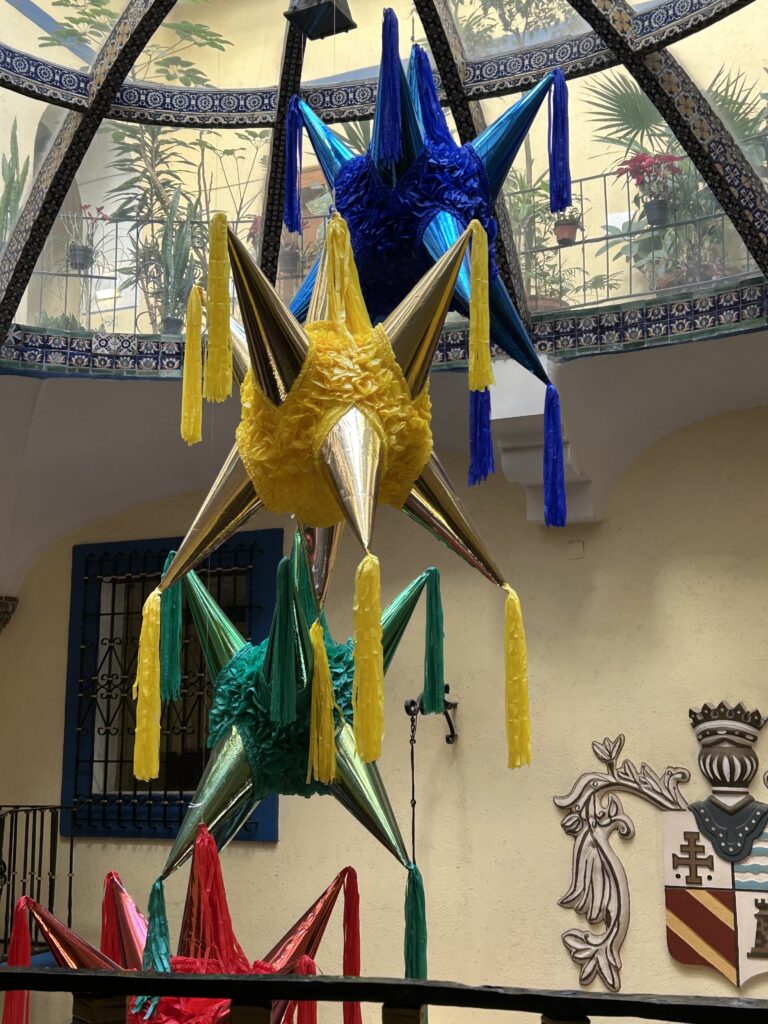
A common shape for the piñata is that of a seven-point star. The star itself symbolizes evil, with the points reportedly representing each of the seven deadly sins. Who was the party pooper who decided to mix in that downer subject with a Christmas fiesta? Then again, it may be a good exercise to think about how the message of Christmas could or should help address the problems caused by those Seven. Grumpy, Dopey, Sneezy – oh wait. Wrong Seven. Sins, not Dwarves. Pride, Envy, and so on.
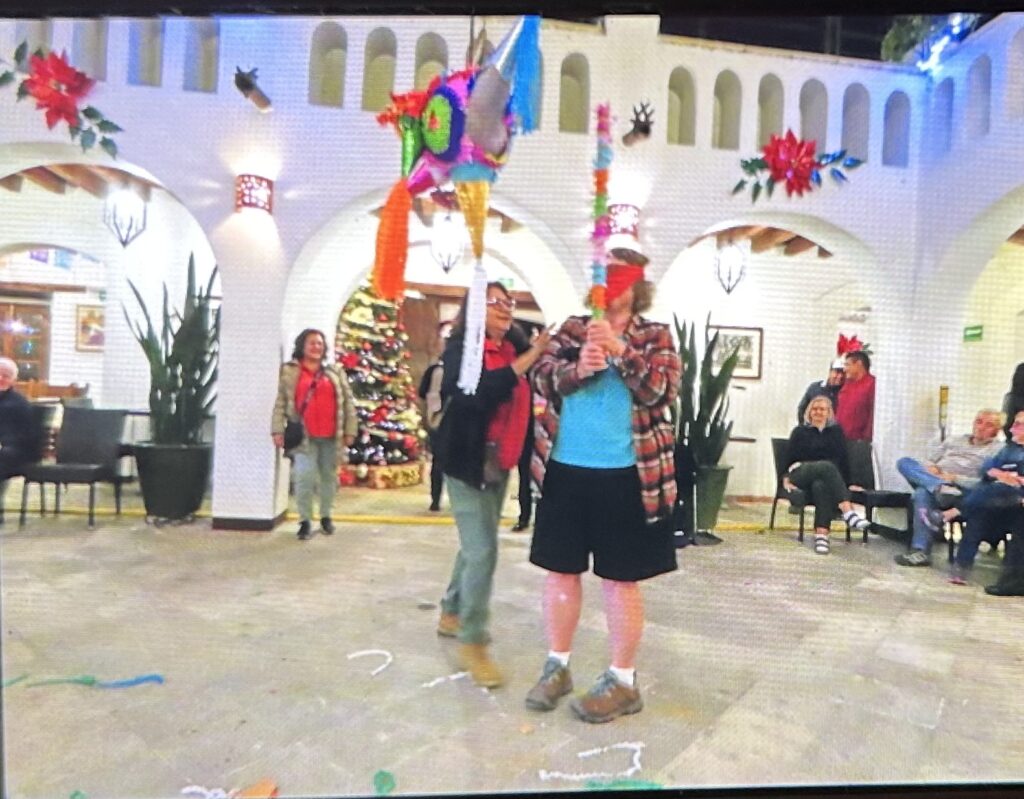
The company organizing our activities in Oaxaca arranged for a superb Christmas pageant in the park across the street from the hotel. Afterwards, they invited neighborhood kids into the hotel lobby to try their luck with the piñata.
If you’re not familiar with it, the piñata comes in many forms and sizes, but is commonly a basketball-sized, decorated clay pot, filled with candy sealed inside. It dangles from a rope, meaning it is a moving target. Contestants are blindfolded, given a large stick, and spun in a circle a few times. After sufficient spinning, (I have read anywhere from 3 to 33 times!) the blindfolded individual is then instructed to swing the baton in hopes of breaking the piñata and spilling the candy. It is a bit like an aerial version of whack-a-mole! It generally takes several solid whacks to crack it—at which point chaos breaks out as kids (and a few adults!) make a mad dash to the floor to corral as much candy as possible.
We were told that whereas the star represented evil and the points were the seven deadly sins, some say the blindfold represents faith. In effect, the would-be faithful person is attempting to bust evil in half and liberate the captive candy, all while operating without the gift of sight. It is a new strategy for overcoming evil, but who knows? So many other efforts have failed why not give it a try? I have always heard Christmas is about liberation; I just never knew candy was involved. For me as a sometimes irreverent, slightly deranged theologian, it was comically satisfying to see these blindfolded kids swinging wildly at the seven deadly sins in the hope that faith would destroy evil and render its sweet temptations harmless on the floor. Their aim was frequently misguided. Their balance was tenuous. They missed more often than they connected. But they were relentless for as long as the baton was in their hands! It may well become my new favorite image to describe our efforts at faithfulness. Imagine that as the center point of evangelistic efforts! How much more successful might that approach be than hell fire, brimstone, and altar calls?
For so long, we have thought of faith as prim and proper. Faith opens our eyes. It is calming. It is declarative, simply stating its truth. It accepts certain things as given, and insists we attempt to believe and trust them. Or if we have an activist mindset, we may be constantly working for change as an expression of faith. In any of those cases, if I’m honest, sometimes it feels as though I’m swinging wildly in the dark as I “work out my salvation with fear and trembling,” to quote the Good Book. There is lots of swinging, plenty of misses, but enough hits to stay encouraged and continue the game. Come to think of it, that is the way golf is for me. I no longer play but when I did, one good drive after a dozen lousy shots could renew my confidence, at least until the next hole!
Piñatas would be easier if the target didn’t move. Just when a good lick indicates in what direction to focus our energy, it changes position and we’re whiffing worse than a batter facing baseball great Nolan Ryan. Life, tradition, and culture continue to butt heads (as they always have); positions and perspectives shift, and what was once acceptable is no longer tolerated. Take smoking as an example. There was a day when doctor’s recommended smoking for relaxation and even improved health. When the mood shifted from an acceptable practice to a new pariah status for those who inhaled. What really changed to facilitate such a broad change of heart in public opinion? I offer this merely as an example, not an endorsement of smoking. The point is that what once was a cornerstone of belief can come into question and be discarded rather rapidly. Positions never before considered can enter the conversation, seeking a recognized place at the table. How do we work out those issues? Clearly, we can’t merely trust public opinion or those who describe themselves as experts.
I’m thinking the piñata may be part of the solution. The sometimes-painful truth is that we figure out much of life “in the dark.” If we wait until we figure it all out, we may never make progress. Even when we think we have seen the light and live accordingly, we may discover our thinking isn’t as clear as we thought. The piñataallows us to swing away. If we can crack open the problem, we have the opportunity to sift through the contents and see what, if anything, is worth maintaining. Next Christmas, I may have to add a pinata to our decorations. Meanwhile, let’s all keep swinging!
