
We’re going to see a tree? Really? Granted, it was the Yuletide season, but this one was not decorated for the holidays. At least not in the traditional sense.
We journeyed a few miles southeast of Oaxaca, Mexico to where the town of Santa Maria del Tule is located. Approximately 8,000 people call that place home. At some point in its history, it was a marshy area complete with bulrushes. Hence the name “Tule”, derived from an indigenous language in the area. Search the internet for things to do there and you’ll learn about a particular tree, plus suggestions listed from surrounding towns. It’s like looking for activities in Richmond and discovering listings that direct you to Connersville, Knightstown, and other surrounding small towns. The opportunities noted are fine, but none of them are in Richmond. Maybe it’s just me but when your greatest attraction isn’t even yours, or there is only one to name, it lowers expectations with regard to the intended destination. But the Santa Maria tree is an impressive site to behold.
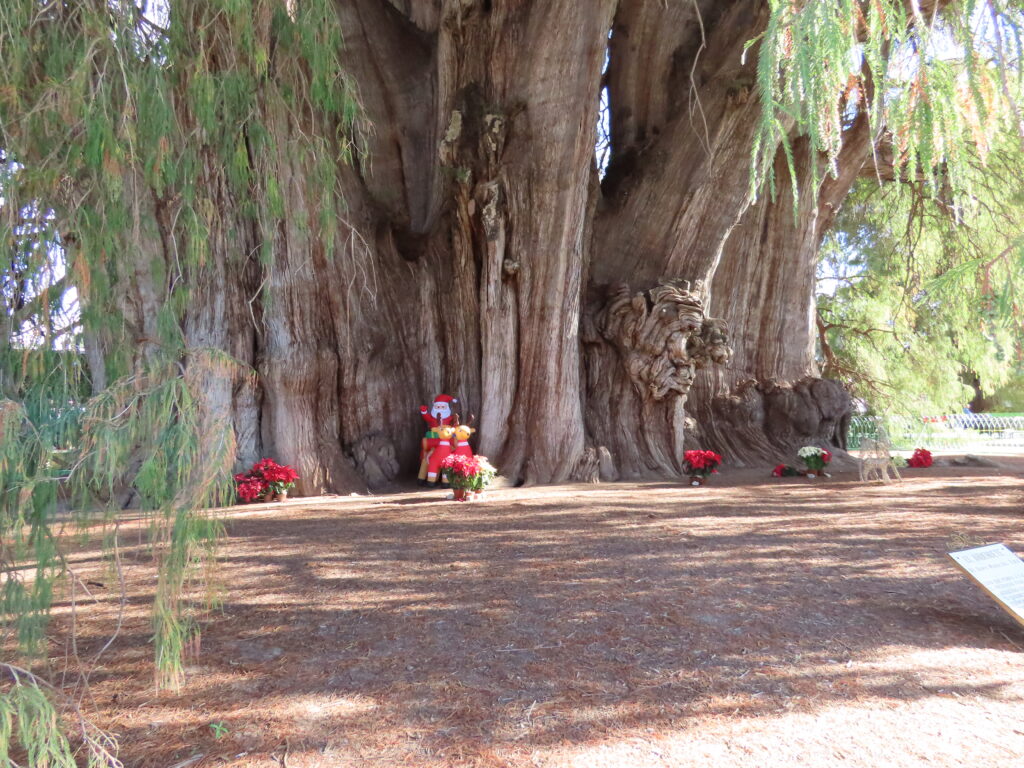
The tree in question is a Montezuma cypress. With a height of 130 feet and a 38-foot diameter, it is said to be one of the tallest and widest in the world. It has not been precisely dated but I’ve seen estimates ranging from 1400 – 3000 years. Imagine one of those persons at the county fair who wants to guess your age – “Step right up, friend. I can guess your age within 1600 years or you win a prize.” That spread seems a little too wide to be trustworthy, but let’s face it — either end of that range is impressive. People apparently like to think they have the largest tree in the world because this is not the first location where I have heard such a claim. Maybe this one is. Maybe it is not. But stand beside it and you’ll agree that at least, it is one big tree.
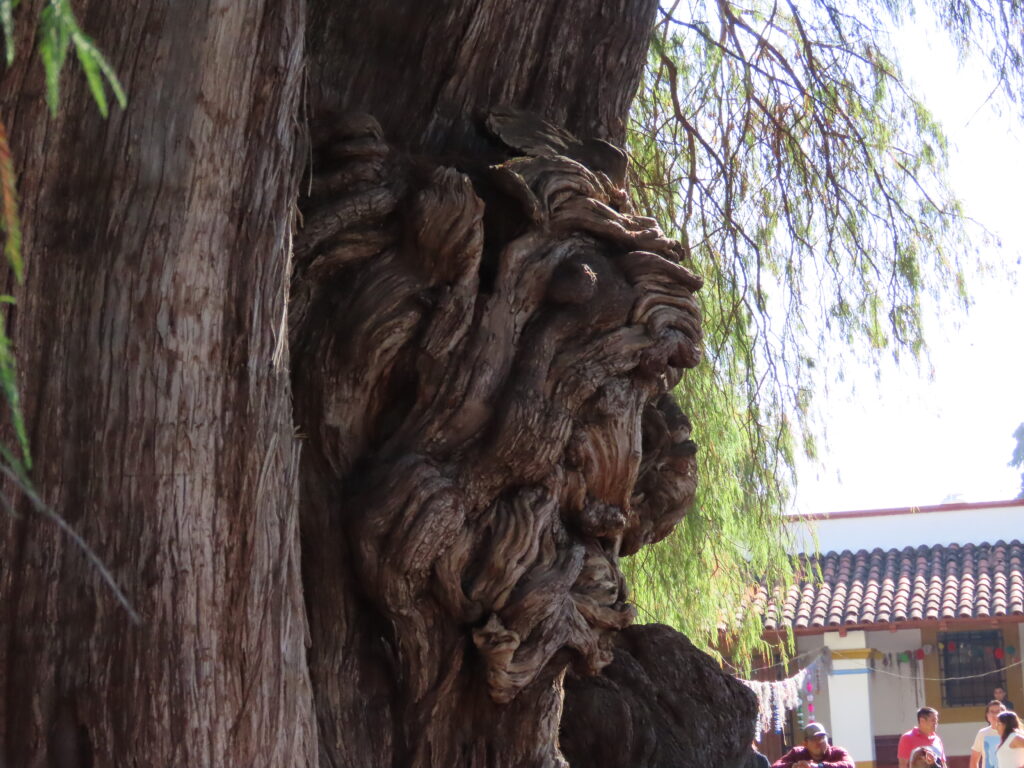
However, there is more than size and age that attracts people to this tree. There is also the fact that its enormous surface is covered with images. Not from defacing by creative kids with a pocketknife looking to immortalize their special moment; these images are created by the eye and the imagination as it observes scars left by all that time and circumstance have inflicted upon it. A limb breaks here and leaves a scraggly nub. A portion of the trunk cracks over there, and its appearance is changed by the fissure. A knot develops in yet another spot. The next thing you know, nature has its own art gallery on display. The collection here includes things like: an elephant, the head of a lion, a crocodile, a deer, a fish, a pineapple, the Three Wise Men, and even a gnome’s house. All totaled, there at least 25 images to admire.
After a brief introduction, our guide for the day handed over the microphone to a young school girl of about 10 or 11 years of age so that she could point out each of the images. It is an honor awarded to the student with the best grades in a nearby school. Her expression was stoic, perhaps partially paralyzed by nervousness, but her presentation was flawless. (Although she did giggle when she pointed out the formation that looked a set of butt cheeks.) Using a small flashlight, she highlighted every formation on the tree as she described it to us. Both she and the tree were quite impressive.
As is often the case, while I listened to the presentation, my mind began its own mini-lecture. It led me to think of how pain in our own lives shapes us, and how we view those moments in retrospect. I think of my life as a largely positive, happy experience, but there have been moments. My dad’s death at age 55 was, perhaps, the most difficult loss I have experienced to date. Even though I was 32 at the time, I remember the deep void and emptiness felt in the loss of someone I could turn to when I had a question I couldn’t answer. One of the people who’d always “had my back” was no longer a phone call away.
As a pastor I had already accompanied several families through moments of loss. I recall thinking that now standing on the other side of that scenario, it would be interesting to learn what, if any, consolation and comfort offered by others was actually helpful in my time of grief. In the spirit of Henri Nouwen’s “wounded healer” concept, would my own pain enable me to become a better source of comfort and healing for others in similar situations? I think that it probably did, though you’d have to ask those I have tried to help to know for certain.
As another example, I haven’t led tours or shined flashlights on the scar from my bypass surgery, but I have sat and shared with a few friends who learned they faced a similar experience. Having lived through it gave my words a bit of credibility.
- “For me, the hardest part was the waiting and anticipation.”
- “You may wonder if anyone got the number of the truck that hit you.”
- “Getting out of bed and taking those first steps afterwards feels like one of life’s greatest victories.”
- “Do the rehab. Do the rehab. Do the rehab.”
And then, there is a frequent occurrence of joy and gratitude when I set out to do something I wish I didn’t have to do, like taking the chainsaw to another ash tree that falls across the driveway. Despite the chore that lies ahead, I notice a giddy-like joy that I am able to do those things. Any day I look in the mirror, the so-called zipper scar stands as a gift of life rather than merely a scar of a past battle.
If TripAdvisor or some other travel site has a list of things to see in Greens Fork where I live, I hope a tour of my life scars never makes the list. You’d pass through some pretty countryside, maybe see a few Amish buggies, and could grab lunch at the only restaurant in town. But the main attraction would be a bust, though I could serve you a good cup of home-roasted coffee.
More to the point, isn’t it interesting how moments of pain and trauma – losing branches, battling disease, or even fighting for our lives – difficult as they are in the moment, can later elicit a different response? The scar ages. Life continues. With time they fold into our larger life narrative. Reflection generates wisdom or compassion that later contributes to how we interpret life or assist others who look to us for answers. The things we learn in the process lend new talents to our bag of tricks.
When you survey the scars of your life, if you are able to look beyond the pain, what else do you see? Shine a little light on them and have a look. They won’t all be as playful as a pineapple or a fish, but still, you may be surprised at how they look in a different light. As it turns out, some scars leave deeper impressions than you might originally recognize.
