
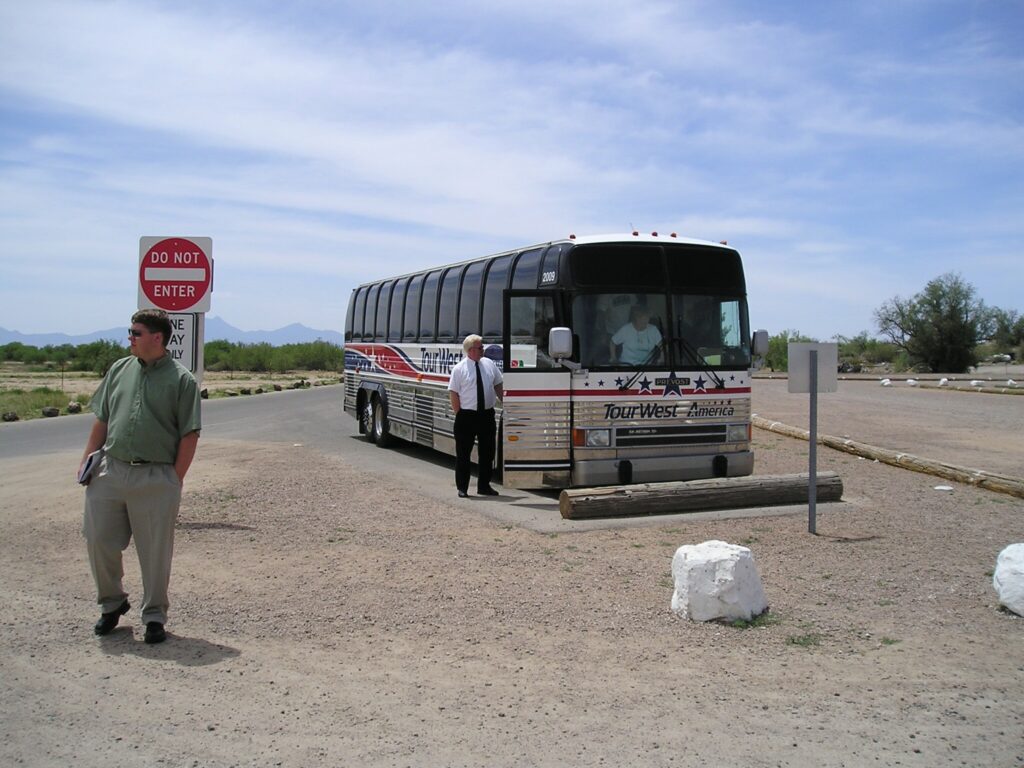
It was one of those “fry an egg on the sidewalk” kind of days where just the thought of venturing outdoors makes you break out in a sweat. After a train ride through the Mexican Copper Canyon, our itinerary had us transferring by bus to the next destination. Eventually, it required that we cross a state border. I don’t recall ever having to pass inspection to cross from Indiana to Kentucky or any other state in the lower forty-eight. People sometimes joke that I have been gone from North Carolina long enough that the authorities should require a passport before allowing me return to the area. Even if my documents were expired, my accent may be enough to allow me to enter. I laugh at that remark, but on this trip, we did experience something similar. Crossing the borders of Mexican states required an inspection. I have no idea if that is always or even usually true – but it was true for us that day.
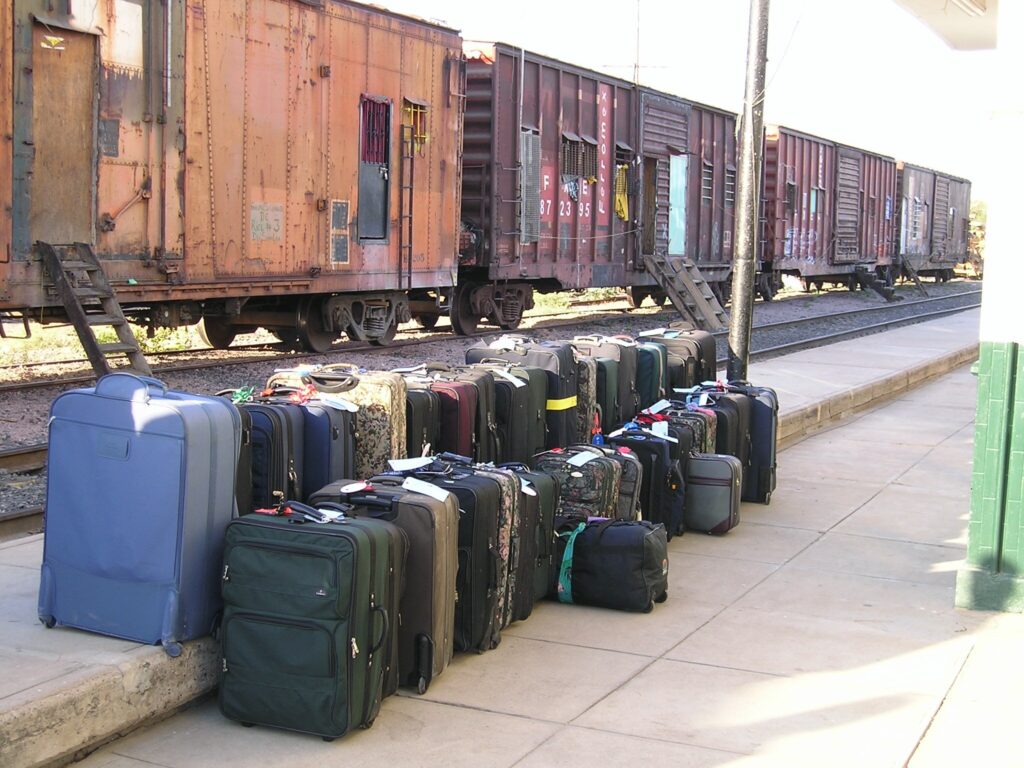
Our guide briefed us about this practice prior to the stop. We wouldn’t know what was required until we actually arrived. There were options. The police could simply wave our entire coach through, allowing us to pass. Or, they could board the vehicle to verify our identity; keep your passport handy we were told. Or, they could require us to exit the coach, retrieve our luggage from underneath the bus, line up single file, and pass through a checkpoint individually. When it was our turn, we were to push a button connected to two lights. Green lights passed through without inspection; red lights — be prepared to have your unmentionables sorted through and displayed in public.
A rather grumpy, uniformed official boarded our coach. He surveyed this harmless group of US tourists. Apparently one or two of us looked suspicious because he ordered us to bring our luggage and form a line. He seemed ready and eager to cause some consternation and delay – so much so that his disappointment was visible when every single one of us received a green light pass and was allowed to return to the coach. We were later told that, according to his staff, he had had an argument with his wife that morning and had been in a sour mood since he arrived to the office.
As we waited our turn and fidgeted in the heat, we couldn’t help but notice a refrigerated truck had been pulled to the side for inspection. The trailer doors were thrown wide open. Inside, two officers had shed their shirts and kicked back in the coolness, enjoying the break from the heat. That was a questionable perk of border patrol power, but that truck was going nowhere soon!
Borders are an interesting concept. One could wonder why they even exist. Is it because something would be too large to function well were it not divided? Is there a difference between one part and the other that merits or requires the distinction? Is one part threatened by the other? Perhaps it is about administrative efficiency or a notion of ownership that entitles one to regulate passage through or usage of an area. Are there things we are trying to keep out or in?
There is an interesting, brief story in the book of Judges of the Old Testament. A border was established between the Gileadites and the Ephraimites. When an Ephraimite sought to cross the fords of the Jordan River into the other’s territory, they were required to pronounce a particular word: shibboleth. If they said it incorrectly, which they were likely to do because of their difficulty pronouncing the letter h, they were not allowed to proceed. Actually, they were killed. I guess those elementary teachers who emphasized the importance of good enunciation were on to something! It also prompts reflection on the purpose and usefulness of borders.
Borders make sense some days. The barrier that warns of danger and prevents accidents is well-placed. And, I must admit I am a fan of property borders. It doesn’t have to be a solid, impassable wall, necessarily. Perhaps a simple marker that indicates when we are crossing to an area that may have different owners or different customs is enough. There was a rusty old fence around some farm land my wife and I owned. Area farmers had long since torn out their fence rows. It made for a neater, well-kept presentation, but I rather liked our old fence even though it was well past its prime. In an area where, even after three decades I’m probably still viewed as the newcomer, I liked that it marked my spot. We eventually allowed the farmer who rented our land to tear out our fences, but somedays I still miss them.
Speaking of borders, my mother died this week. Hers was a good, long life. She was fortunate to be able to remain at home and take her last breath in her own bed. This was largely thanks to my sisters who lived in the area and could provide the needed support. It was time, but still a tremendously sad moment. I miss her already! I mention it because death is another “border crossing” kind of moment. We speak of crossing over to the other side. It differentiates what is here and knowable and what is beyond and unknowable except by the eyes of faith. Hopefully any necessary credentials to make that journey are already known. In some ways, the idea of St. Peter as the keeper of the pearly gates makes him is an eternal kind of “ICE.” I can only hope he has less intimidating tactics than the ones that make news headlines here. Whatever the case, I suppose death is an example where the idea of a border makes sense. Death alters reality. It is new territory, a different reality. While not completely disconnected from this world, getting there is not the same as crossing the county line. What was once is now no more; whatever will be will not be the same.
As for borders that may be more questionable, let me acknowledge that this world is more complicated than I know. There may well be a good reason to rifle through the luggage of senior citizen tourists while on holiday, no matter how unbearably hot the day is. Maybe there are criminals and other undesirables in the camps that hold others who have crossed the border without proper permission. It can be helpful to clarify boundaries and establish expectations. But I’m guessing we could do a better job managing those situations. Who knows, with a bit of relational bridge-building, we may get by with fewer.
Recently when thinking about immigration control in this country, I found myself praying that those who have power and authority to detain would fulfill their jobs with compassion, resisting force and violence. Years ago, a supervisor of mine advised me, when exercising my own oversight of others, to always be warm, kind, and firm. That was priceless advice. I’m advocating some version of that at border crossings, whatever they seek to preserve or protect. Because not all strangers are threats. Not everyone is up to no good. Some are just on holiday!
